
What's Happening?
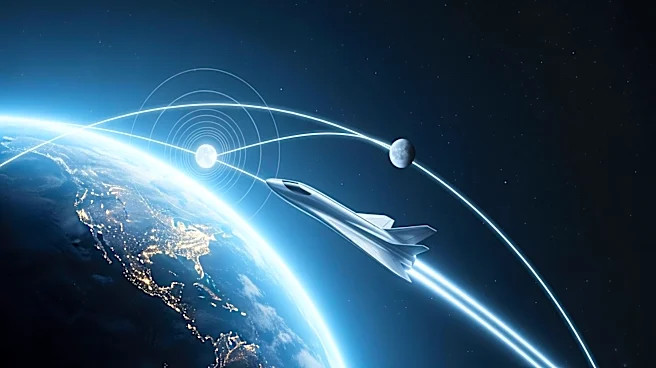
An international team of researchers has identified a more efficient route for spacecraft traveling between Earth and the moon, utilizing advanced computer modeling. This new path, discovered through the theory
of functional connections, significantly reduces fuel consumption by 58.80 meters per second compared to previously known routes. The study, published in the journal Astrodynamics, involved simulating 30 million potential routes, with 280,000 simulations referenced in the final analysis. The researchers found that approaching the lunar orbit from the side opposite Earth allows for better gravity-based propulsion, which is crucial for reducing fuel use. This discovery could also help maintain uninterrupted communication with Earth, addressing issues like those experienced during the Artemis 2 mission, which temporarily lost contact when it moved behind the moon.
Why It's Important?
The discovery of a more fuel-efficient route to the moon has significant implications for space exploration and the economics of space travel. By reducing fuel consumption, space missions can become more cost-effective, potentially saving millions of dollars. This could make lunar missions more accessible and frequent, benefiting scientific research and commercial endeavors. Additionally, maintaining continuous communication with Earth is vital for mission safety and success, making this new route particularly valuable. The approach of using gravity for propulsion aligns with the Interplanetary Transportation Network's principles, which aim to minimize fuel use by leveraging gravitational forces. This advancement could pave the way for more sustainable and efficient space travel, influencing future mission planning and execution.
What's Next?
While the newly discovered route offers promising benefits, researchers acknowledge that it may not be the ultimate solution for low-cost Earth-moon travel. Future studies are expected to incorporate additional gravitational influences, such as the sun's gravity, which could lead to even more efficient pathways. The systematic analysis method used in this study could be applied to other celestial routes, potentially uncovering further cost-saving opportunities. As space agencies and private companies continue to plan lunar missions, the integration of these findings could enhance mission design and execution, fostering advancements in space exploration technology and strategy.