

What's Happening?
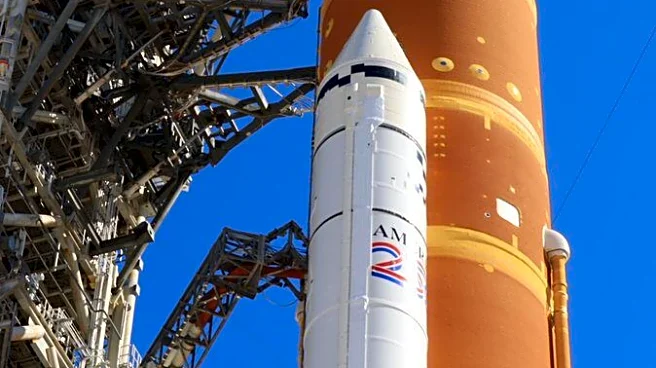
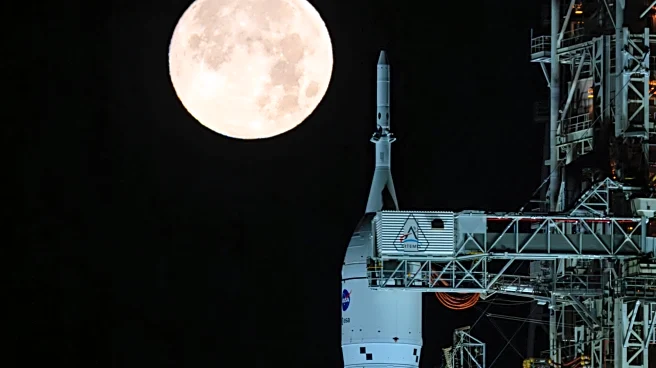
NASA has announced that the Artemis II mission, which will send four astronauts on a round-trip to the moon, is scheduled for launch on March 6. This mission marks the first crewed moon mission in over 50 years. The announcement follows a successful wet
dress rehearsal (WDR) at NASA's Kennedy Space Center, where the Space Launch System (SLS) rocket and Orion spacecraft were tested. The WDR involved a full simulation of the launch process, including the fueling of the rocket with cryogenic liquid hydrogen and oxygen. This was the second WDR for Artemis II, as the first was halted due to a hydrogen leak. The successful completion of this test indicates that the issues encountered during the Artemis I mission have been addressed. The Artemis II mission will include NASA astronauts Reid Wiseman, Victor Glover, Christina Koch, and Canadian Space Agency astronaut Jeremy Hansen.
Why It's Important?
The Artemis II mission is a significant step in NASA's efforts to return humans to the moon and eventually establish a sustainable presence there. This mission will test the capabilities of the SLS rocket and Orion spacecraft with a crew on board, paving the way for future lunar exploration. The success of Artemis II is crucial for the continuation of the Artemis program, which aims to land the first woman and the next man on the moon by the mid-2020s. This mission also represents international collaboration, as it includes a Canadian astronaut, highlighting the global interest in lunar exploration. The advancements and data gathered from this mission could have far-reaching implications for space exploration and technology development.
What's Next?
Before the Artemis II mission can proceed, NASA must complete a comprehensive flight readiness review, which is expected to occur soon. The astronauts will enter quarantine as a precautionary measure before the launch. If successful, Artemis II will set the stage for Artemis III, which aims to land astronauts on the lunar surface. The mission's success could also influence future international partnerships and funding for space exploration initiatives. As the launch date approaches, NASA will continue to monitor and prepare the spacecraft and crew for the mission.