








What's Happening?
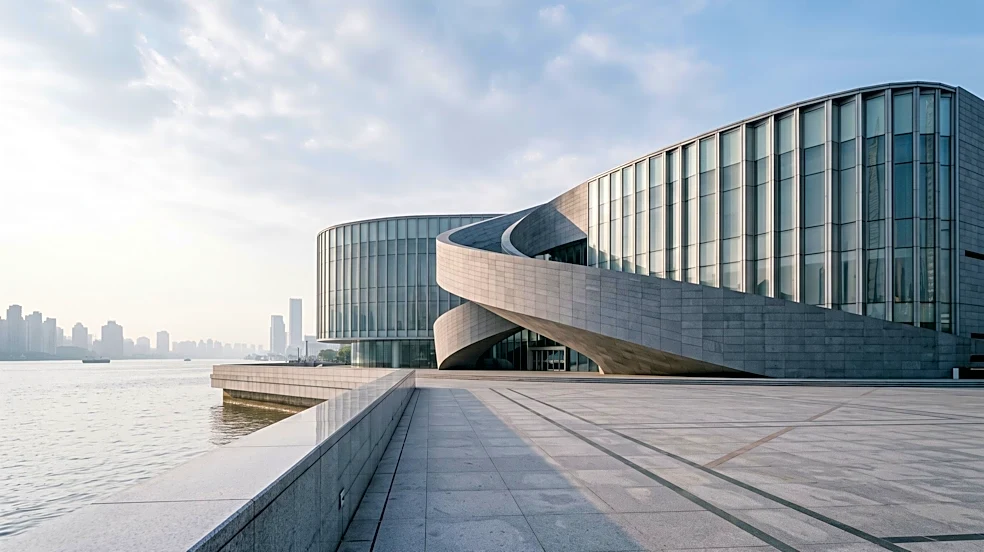
International studio Snøhetta has completed the Shanghai Grand Opera House, a 146,786-square-meter cultural landmark situated on the Huangpu River waterfront in Shanghai, China. The design emphasizes its role as both a performance venue and a civic destination,
featuring a prominent spiral staircase that leads to a publicly accessible rooftop. This rooftop can function as a stage, observation deck, or meeting point, aiming to integrate the building into the urban fabric. Snøhetta co-founder Kjetil Thorsen highlighted the studio's approach of understanding the site's context to create a building that resonates with its surroundings and users. The opera house includes three auditoriums with a combined capacity of 4,200 people, along with exhibition spaces, educational facilities, restaurants, and rehearsal areas. The main auditorium, Harmony Hall, seats 2,000, while the Soar Theatre accommodates 1,200, and a flexible third auditorium holds 1,000 for experimental performances. The facade alternates between transparent and opaque finishes to balance privacy and openness, with expansive glass elements in the lobby maximizing natural light and views.
Why It's Important?
The completion of the Shanghai Grand Opera House signifies a notable development in global architectural design and urban planning, particularly in how cultural institutions can be integrated into public life. Snøhetta's emphasis on creating a civic destination, rather than solely a performance venue, challenges traditional notions of opera houses as exclusive spaces. This approach could influence future urban cultural projects worldwide, promoting accessibility and community engagement. The design's focus on context and public realm integration demonstrates a model for creating landmarks that are embraced by local residents and visitors alike, fostering a sense of ownership and belonging. Furthermore, the inclusion of flexible performance spaces caters to diverse artistic expressions, potentially broadening the appeal of opera and other performing arts to younger generations and wider audiences. The project also showcases sustainable design elements, such as passive strategies for energy efficiency and durable materials, setting a precedent for large-scale cultural buildings to minimize their environmental footprint.
What's Next?
With its completion, the Shanghai Grand Opera House is poised to become a significant cultural hub in Shanghai, hosting a variety of musical performances and public events. The accessible rooftop and integrated public spaces are expected to draw both ticket holders and general visitors, transforming the area into a vibrant civic gathering point. The flexible third auditorium, designed for experimental performances, suggests a future of diverse and innovative artistic programming, potentially attracting new audiences to the performing arts. The building's design, which prioritizes public access and contextual integration, may serve as a case study for urban planners and architects globally, influencing the development of future cultural infrastructure projects. Its operational success and public reception will likely be closely monitored as a model for how large-scale cultural buildings can contribute to urban vitality and community engagement.
Beyond the Headlines
Beyond its immediate function as an opera house, the Shanghai Grand Opera House represents a broader philosophical shift in architectural design towards creating inclusive public spaces. Snøhetta's deliberate effort to 'reduce thresholds' and make the building part of everyday life reflects a growing trend to democratize cultural institutions. This approach challenges the traditional elitism often associated with opera houses, aiming to make high culture accessible to a wider demographic. The design's success in feeling 'so Chinese' despite being designed by an international firm underscores the importance of deep contextual understanding and collaboration in global architectural projects. This project could inspire further dialogue on cultural authenticity in design and the role of architecture in fostering cross-cultural understanding. The integration of sustainable design principles also highlights a growing ethical imperative for large-scale developments to address environmental concerns, setting a benchmark for future cultural infrastructure worldwide.