
What's Happening?
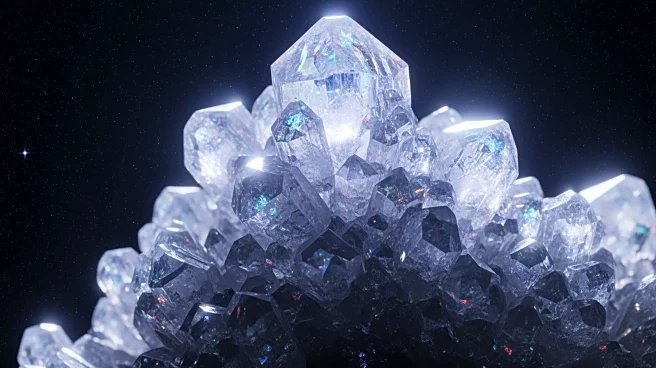
Scientists using NASA's James Webb Space Telescope have discovered the formation site of crystalline silicates, providing insights into their presence in comets. These silicates, which require intense
heat to form, have been found in ultracold regions like the Kuiper Belt and Oort Cloud. The research team utilized Webb's Mid-Infrared Instrument to observe a protostar, EC 53, and found that crystalline silicates form in the hot inner part of the protoplanetary disk surrounding the star. The study, published in Nature, explains that the star's powerful outflows can propel these silicates to the disk's edge, where comets are typically located.
Why It's Important?
This discovery is significant as it resolves a longstanding mystery about the presence of heat-formed crystalline silicates in comets, which are expected to be icy. Understanding the distribution and formation of these particles can enhance our knowledge of comet composition and the early solar system. The findings could influence future research on cometary materials and their role in the solar system's evolution. This study also demonstrates the capabilities of the James Webb Space Telescope in advancing our understanding of cosmic phenomena.