





What's Happening?
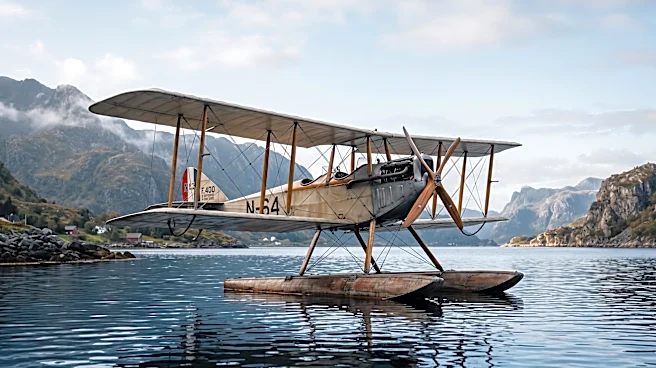
The Marinens Flyvebaatfabrikk M.F.5 was a biplane floatplane developed in Norway for the Royal Norwegian Navy Air Service. Assembled at Marinens Flyvebaatfabrikk starting in 1918, its design was based on the Sopwith Baby. This aircraft marked a significant
development as it was the first model from the manufacturer to operate in a tractor configuration. The M.F.5 served as a primary reconnaissance aircraft for eight years, with eight units deployed from Karljohansvern in Horten. Additionally, one unit was retained for training purposes. Despite being the largest production run for the Navy by the manufacturer at the time, the M.F.5 was not considered a success and was eventually replaced by the MF9 model, of which ten were manufactured starting in 1926.
Why It's Important?
The development and deployment of the Marinens Flyvebaatfabrikk M.F.5 highlight early efforts in naval aviation technology and indigenous aircraft production in Norway. Its role as a primary reconnaissance aircraft underscores the evolving importance of aerial surveillance in naval operations during the post-World War I era. The transition from the M.F.5 to the MF9 indicates a continuous drive for improvement and adaptation in military aviation, reflecting the rapid technological advancements of the period. Although the M.F.5 itself was not deemed a success, its production and operational history provide valuable insights into the challenges and learning curves associated with establishing domestic aircraft manufacturing capabilities and integrating new technologies into military forces. This period laid foundational knowledge for future naval aviation developments.
What's Next?
The M.F.5 was replaced by the MF9 from 1926, with ten units of the latter being manufactured. This transition suggests a continuous evolution in naval aircraft design and operational requirements for the Royal Norwegian Navy Air Service. Future developments would likely focus on improving aircraft performance, reliability, and mission-specific capabilities, building upon the experiences gained from models like the M.F.5. The ongoing need for reconnaissance and training aircraft would drive further innovation and procurement decisions, potentially involving more advanced designs and technologies as they became available. The shift to the MF9 indicates a clear path towards more effective and successful aircraft models for naval operations.
Beyond the Headlines
The story of the Marinens Flyvebaatfabrikk M.F.5 reflects the broader historical context of nascent aviation industries in smaller nations during the early 20th century. It illustrates the challenges of developing and producing military aircraft domestically, often relying on foreign designs as a starting point. The M.F.5's limited success and subsequent replacement underscore the rapid pace of technological change in aviation during this era, where designs could quickly become obsolete. This period was crucial for establishing the infrastructure and expertise necessary for future aerospace endeavors, even if individual projects faced limitations. The experience gained from such projects contributed to the long-term development of national defense capabilities and technological self-sufficiency.