





What's Happening?
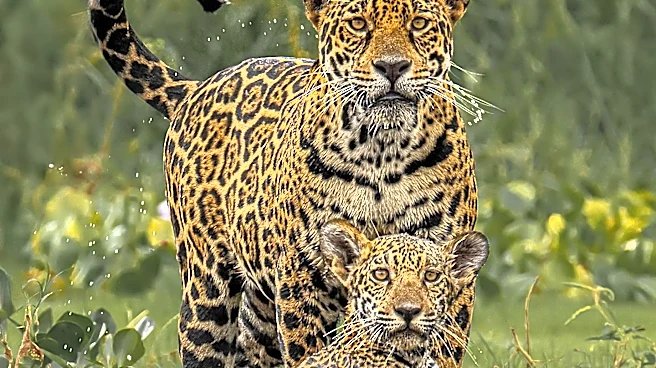
A new research paper published in the journal Ecology and Evolution has documented four instances of interactions, killings, and predation between jaguars, pumas, and ocelots in South American tourist hotspots: the Pantanal in Brazil and the Llanos of Colombia.
These observations, often made by tourists, include a jaguar chasing a puma, a jaguar feeding on an ocelot carcass it appeared to have killed, and a puma found killed and partially consumed by a jaguar. Lead author Fernando Tortato of the big cat conservation group Panthera emphasizes that these observations, enabled by ecotourism, provide rare insights into the behavioral ecology of these carnivores. The study highlights that jaguars, being the largest of the three, influence the distribution of pumas and ocelots through predation and competition for resources.
Why It's Important?
This research is significant because it provides direct evidence of interspecific killing among large carnivores, a phenomenon that plays a crucial role in structuring carnivore communities but has historically been difficult to document. While interspecific killing is known to be common among mammalian carnivores, accounting for a substantial percentage of mortalities, concrete evidence has been scarce. The study demonstrates how jaguars, as apex predators, can limit the populations and spatial distribution of other large felids like pumas and ocelots. This understanding is vital for conservation efforts, as it helps in comprehending the complex dynamics of predator communities and the factors that maintain ecosystem balance. The involvement of ecotourism in gathering this data also highlights its potential as a tool for scientific research and conservation monitoring.
What's Next?
The findings suggest a need for continued monitoring of these carnivore interactions, particularly in tourist-accessible areas, to further understand their frequency and impact on population dynamics. Conservation strategies for these big cat species may need to account for these competitive and predatory relationships to ensure the health and stability of their populations. The role of ecotourism as a platform for scientific observation could be further developed, potentially leading to more citizen science initiatives that contribute valuable data to wildlife research. Researchers may also explore how environmental changes, such as habitat fragmentation or prey availability, might alter these interspecific dynamics in the future.
Beyond the Headlines
The observed conflicts between jaguars and pumas offer a glimpse into the raw, competitive nature of wildlife, where survival often depends on dominance and resource control. This dynamic is not merely about individual encounters but reflects a fundamental ecological principle: the structuring of communities through interspecies competition and predation. The fact that tourists are witnessing these events underscores the increasing human presence in natural habitats and the potential for ecotourism to both support and inadvertently influence wildlife behavior. It also raises ethical questions about the balance between observing nature and potentially disturbing it, as well as the responsibility of tourists and tour operators to contribute to conservation efforts rather than merely consuming wildlife spectacles.