






What's Happening?
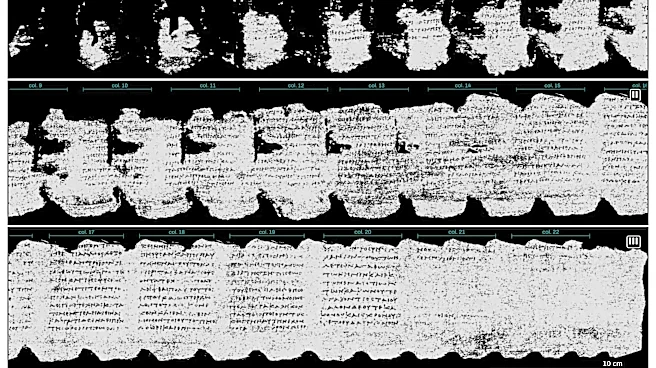
A team associated with the University of Kentucky's Vesuvius Challenge has successfully deciphered the PHerc. 1667 scroll, a document preserved by the eruption of Mount Vesuvius nearly 2,000 years ago. This achievement marks the first time an entire scroll from
the Villa of the Papyri has been read without being physically unrolled. The scroll, believed to be part of the only surviving Greco-Roman library, was deciphered using advanced phase-contrast X-ray microtomography, a technique that involves scanning with a particle accelerator and synchrotron. The scroll contains a philosophical treatise on ethics, discussing human nature and moral progress, and is dated between the second and third century B.C.E. This places it among the oldest scrolls in the villa, potentially authored by a figure other than the villa's most famous writer, Philodemus of Gadara.
Why It's Important?
The successful deciphering of the PHerc. 1667 scroll represents a significant breakthrough in the study of ancient texts, offering a scalable method for reading other fragile documents without causing damage. This advancement could revolutionize the field of archaeology and history by providing access to previously unreadable texts, thereby enriching our understanding of ancient cultures and philosophies. The findings could also influence the study of Stoic and Epicurean philosophies, as the scroll's content suggests connections to these schools of thought. The ability to read such texts without physical handling reduces the risk of damage, preserving these invaluable cultural artifacts for future study.
What's Next?
Following this success, the Vesuvius Challenge plans to apply the same techniques to other scrolls from the Villa of the Papyri. This could lead to further discoveries and insights into ancient Roman and Greek thought. The ongoing efforts to decode additional scrolls may reveal more about the authors and the content of these ancient texts, potentially reshaping historical narratives. The project also continues to engage computer scientists worldwide, offering incentives to develop new methods for reading these ancient documents.