
What's Happening?
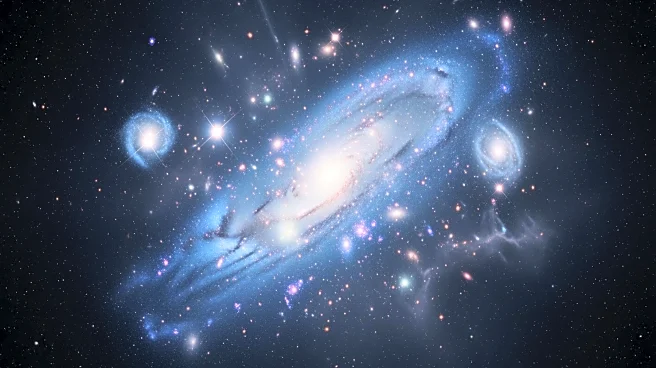
An international team of astronomers has discovered an extremely hot galaxy cluster, SPT2349-56, dating back to 1.4 billion years after the Big Bang. This cluster is far hotter and older than current cosmological
theories allow, suggesting a more explosive evolution of galaxy clusters than previously thought. The cluster's core, measuring half a million light-years across, is believed to have gained energy from gravitational interactions between multiple supermassive black holes. This discovery challenges existing models of how the early universe evolved and could lead to a reevaluation of cosmological theories.
Why It's Important?
The discovery of this 'impossible' galaxy cluster could significantly impact our understanding of the early universe and the formation of galaxy clusters. It suggests that current models may not fully account for the processes that shaped the universe's evolution. This finding could lead to new theories about the role of supermassive black holes in galaxy formation and the energy dynamics of the early universe. The research highlights the need for further exploration and study of the universe's oldest regions to refine our understanding of cosmology.
What's Next?
Astronomers will continue to study the SPT2349-56 cluster to understand the mechanisms behind its extreme heat and age. Further observations and analyses will focus on the interactions between supermassive black holes and their impact on galaxy cluster evolution. This research could lead to new insights into the formation of the universe's largest structures and the role of black holes in cosmic evolution. The findings may prompt revisions to existing cosmological models and inspire new theoretical frameworks.