





What's Happening?
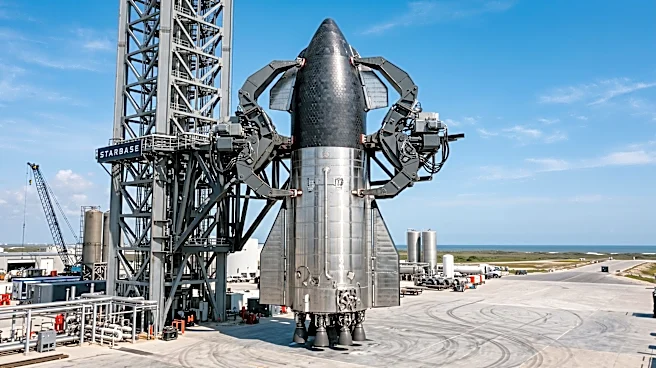
SpaceX CEO Elon Musk announced that the Starship upper stage from Flight 15, Ship 42, will likely be placed on public display rather than being reflown. This decision stems from the historic significance of Ship 42, as its successful catch marked the first
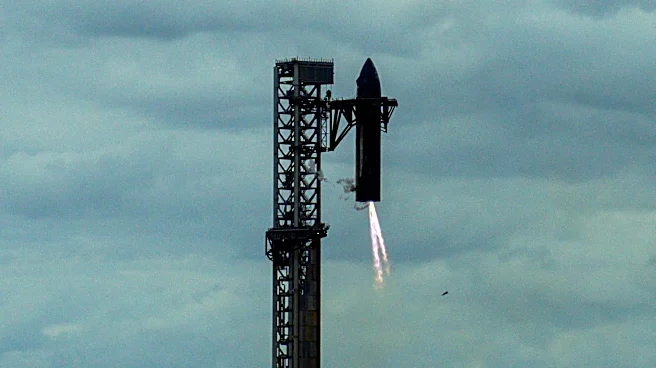
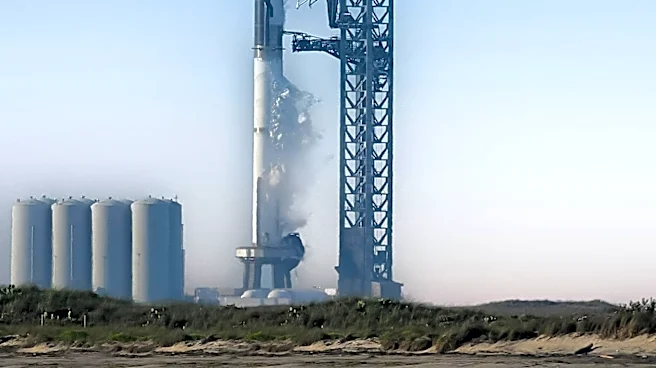
time a Starship upper stage was recovered in good enough condition for potential reuse. The achievement, confirmed during Musk's virtual appearance at the TomorrowX Summit in Austin on November 18, signifies that all major components of Starship can now be flown to space and recovered. The Flight 15 mission, launched on November 13 from Starbase, Texas, was Starship's longest to date, with the upper stage coasting in space for over 21 hours before deorbiting and being caught by the launch tower. While the Super Heavy Booster's catch was aborted due to an engine failure and fuel issues, the successful recovery of Ship 42 is considered a critical milestone for SpaceX's reusability goals.
Why It's Important?
The successful recovery of Starship's upper stage is a pivotal development for the future of spaceflight economics. Elon Musk emphasized that this achievement is expected to reduce the cost of accessing space by up to 100 times. This drastic cost reduction could unlock the potential to deliver millions of tons of payload to orbit annually, fundamentally transforming the space transportation industry. The ability to routinely recover and reuse both stages of Starship means that space missions could become significantly more affordable and frequent, opening new possibilities for satellite deployment, deep space exploration, and even space tourism. This breakthrough positions SpaceX as a leader in reusable rocket technology, potentially accelerating the development of a sustainable and scalable space economy. The shift from recovery to routine, rapid reuse is the next crucial step that will redefine the economics of spaceflight.
What's Next?
SpaceX plans to focus on transitioning from successful recovery to routine, rapid reuse of Starship components. While Ship 42 will be preserved for public display due to its historic nature, future Starship upper stages are intended for reflight after minor repairs. The company is also preparing for the introduction of Starship V4, which will feature a taller upper stage, increased propellant capacity, and more powerful Raptor engines. The next Starship mission is targeted for December, potentially launching from NASA’s Kennedy Space Center. However, improvements to the Super Heavy Booster are necessary following its underperformance on Flight 15, which included an engine restart failure and guidance system issues. Addressing these booster challenges will be critical for ensuring the full reusability and reliability of the Starship system in upcoming missions.
Beyond the Headlines
The successful recovery of Starship's upper stage has profound implications beyond immediate cost savings and mission frequency. It represents a significant leap towards making humanity a multi-planetary species, a long-term goal articulated by Elon Musk. The ability to transport massive payloads to orbit at a fraction of the current cost could enable the construction of large-scale space infrastructure, facilitate lunar and Martian colonization efforts, and support ambitious scientific endeavors. This technological advancement also challenges traditional aerospace paradigms, pushing the entire industry towards greater innovation in reusability. Furthermore, the development of fully reusable space transportation systems could foster new industries and economic opportunities in space, ranging from resource extraction to in-orbit manufacturing, ultimately expanding humanity's presence and capabilities beyond Earth.