
What's Happening?
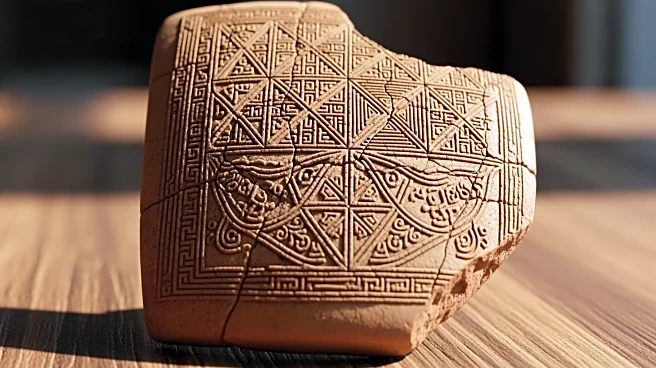
Recent research into Halafian pottery from ancient Mesopotamia has uncovered evidence of an early mathematical system. The Halafian culture, which thrived around 8,000 years ago, is known for its intricate
pottery decorated with geometric patterns and botanical motifs. According to Professor Yosef Garfinkel of Hebrew University, these decorations suggest a sophisticated understanding of mathematics, with floral motifs arranged in sequences of numbers such as 2, 4, 8, 16, 32, and 64. This discovery indicates that the Halafians had developed a mathematical system predating the well-known Sumerian system. The pottery also features depictions of dancers, which may be linked to shamanistic rituals, suggesting a complex cultural and spiritual life.
Why It's Important?
The findings about the Halafian culture's mathematical system provide significant insights into the development of early human societies. This discovery challenges the traditional timeline of mathematical development, suggesting that complex mathematical concepts were in use much earlier than previously thought. The implications extend to our understanding of how early societies organized themselves, managed resources, and developed cultural practices. The presence of shamanistic rituals and complex art forms indicates a rich cultural life, which could reshape our understanding of social and spiritual practices in prehistoric times.