
What's Happening?
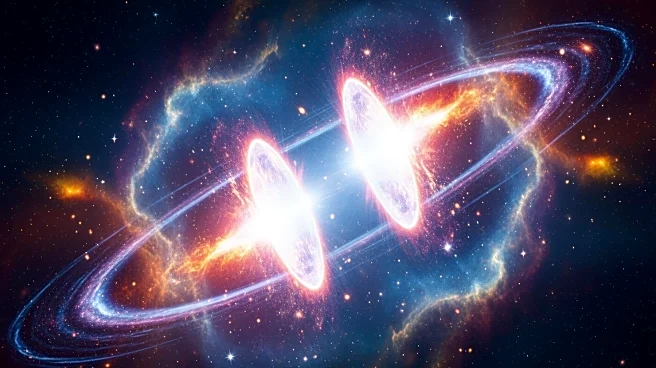
Astronomers using the James Webb Space Telescope (JWST) have discovered the type of stellar body that remains after two stars collide and merge, resulting in a luminous red nova. The research, led by Andrea
Reguitti from the Istituto Nazionale Di Astrofisica, found that these events leave behind a supermassive star similar to a red supergiant. The study involved analyzing nine luminous red novas, with particular focus on two events, AT 2011kp and AT 1997bs, observed years after their initial occurrence. The JWST's infrared capabilities, along with data from the Hubble and Spitzer Space Telescopes, allowed researchers to observe these stellar mergers and the resulting supermassive stars, which are cooler and larger than the sun. The findings suggest that such stellar mergers could contribute to the interstellar dust that forms the building blocks of life.
Why It's Important?
This discovery is significant as it provides insights into the life cycle of stars and the formation of supermassive stars, which are crucial for understanding the evolution of galaxies. The research highlights the role of stellar mergers in producing interstellar dust, which contains carbon compounds essential for life. By understanding these processes, scientists can better comprehend the conditions that lead to the formation of life-supporting environments in the universe. Additionally, the study demonstrates the capabilities of the JWST in observing distant cosmic events, paving the way for future astronomical discoveries.