




What's Happening?
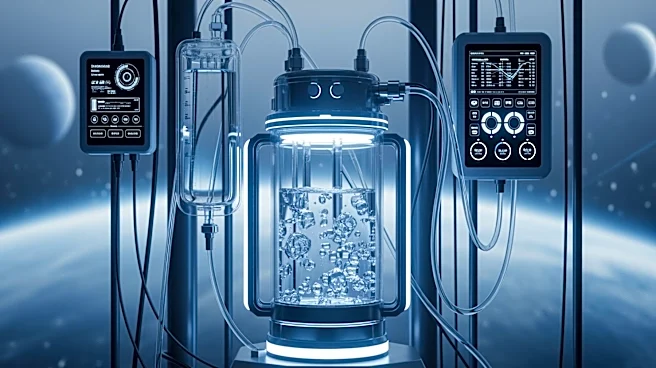
NASA has developed a new technology, known as IntraVenous Fluid GENeration Miniaturized (IVGEN Mini), to produce medical-grade IV fluid in space. This system, installed on the International Space Station, filters drinking water to create IV fluid, addressing
the challenge of limited shelf life for prepackaged IV fluid on long-duration space missions. The IVGEN Mini system, which flew to the station on April 11, 2026, will undergo demonstrations to verify its functionality in space. This innovation is crucial for ensuring crew health on missions beyond low Earth orbit, where IV fluid may be needed for medical conditions such as dehydration and burns.
Why It's Important?
The development of IVGEN Mini represents a significant advancement in space medicine, enabling the production of IV fluid on demand during long-duration missions. This technology addresses the limitations of prepackaged IV fluid, which has a shelf life of only 16 months, and reduces the need for carrying large quantities of fluid on missions to the moon or Mars. By ensuring a reliable supply of IV fluid, NASA can better support crew health and safety, reducing risks associated with medical emergencies in space. This innovation also highlights NASA's commitment to developing technologies that support human exploration of deep space.
What's Next?
NASA plans to conduct further testing of the IVGEN Mini system aboard the International Space Station, with operations scheduled for May. The system will produce 10 liters of IV fluid, which will be returned to Earth for analysis to ensure it meets safety and quality standards. The successful demonstration of IVGEN Mini will pave the way for its use on future deep space missions, where it will play a critical role in maintaining crew health. NASA will continue to refine the technology and explore additional applications for space medicine.