







What's Happening?
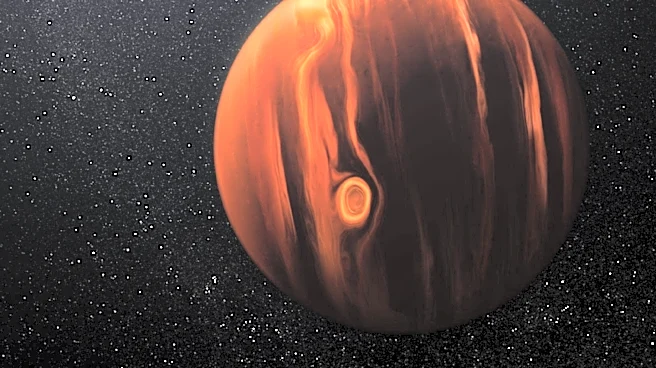
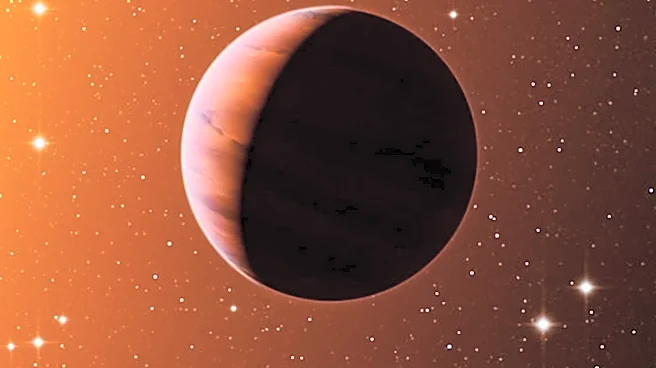
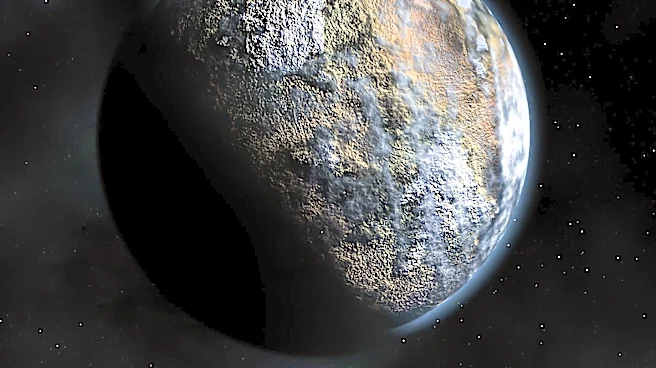
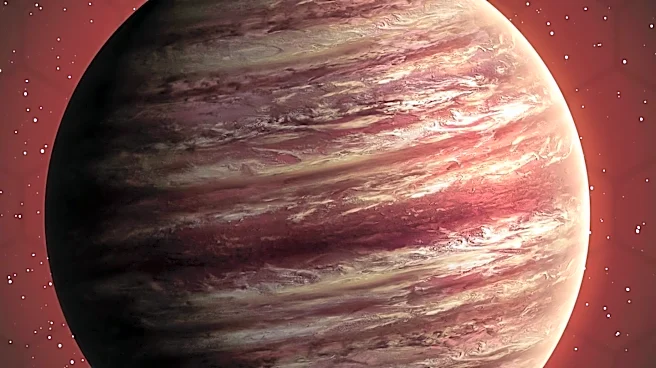
Researchers have potentially discovered the first exomoon, named CD-35 2722 B, orbiting a brown dwarf rather than a traditional planet. This discovery, led by Kevin Hoy, a PhD student at the Instituto de Estudios Astrofísicos, marks a significant milestone
in the study of celestial bodies outside our solar system. The exomoon is approximately 90% the size of Jupiter and larger than Saturn, taking 170 days to orbit its host. The discovery was made using radial velocity analysis, a technique that detects wobbles in stars to indicate the presence of nearby exoplanets. This method, previously used to detect the first exoplanet, has now provided evidence of a satellite around a brown dwarf. However, the findings are controversial due to the lack of a standard definition for what constitutes a moon, as the International Astronomical Union has not yet defined such terms for exomoons.
Why It's Important?
The discovery of CD-35 2722 B challenges existing astronomical definitions and could reshape our understanding of celestial bodies. The lack of a clear definition for moons, especially in the context of brown dwarfs, highlights the complexities in classifying such objects. This finding could prompt the International Astronomical Union to establish new criteria for defining moons and planets, potentially impacting future astronomical research and exploration. The discovery also underscores the importance of advanced detection techniques like radial velocity analysis in expanding our knowledge of the universe. As researchers continue to explore these celestial phenomena, the potential for discovering more exomoons could provide insights into the formation and evolution of planetary systems.
What's Next?
The astronomical community may need to address the classification challenges posed by CD-35 2722 B. The International Astronomical Union might consider developing a formal definition for exomoons, which could influence how future discoveries are categorized. Researchers will likely continue to study CD-35 2722 B to gather more data and refine their understanding of its characteristics. This discovery could also encourage further exploration of brown dwarfs and their potential to host moons, expanding the scope of exoplanetary research. As new techniques and technologies emerge, the search for exomoons and other celestial bodies will likely intensify, offering new opportunities for scientific breakthroughs.