





What's Happening?
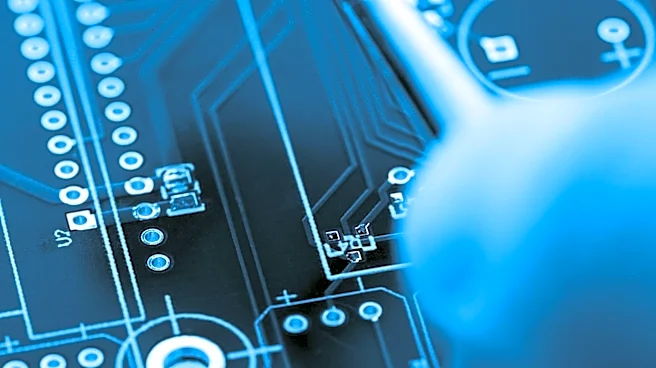
Arizona State University (ASU) and Taiwan's National Yang Ming Chiao Tung University (NYCU) are expanding their collaboration beyond their existing work in the semiconductor field. A delegation from NYCU, including its president, Chi-Hung Lin, recently
visited ASU to explore new opportunities for faculty and student exchanges, joint research projects, and the development of undergraduate and graduate programs. This initiative builds on ASU's efforts to strengthen ties with Taiwanese institutions, particularly in support of Arizona's growing semiconductor economy. NYCU's proximity to TSMC headquarters in Hsinchu Science Park and its history of joint semiconductor research and workforce development make it a key partner for ASU, which is also advancing in these areas. The collaboration aims to leverage the innovative spirit of both universities across various disciplines, including social sciences, biotech, medical engineering, quantum, and physics.
Why It's Important?
This enhanced collaboration is significant for several reasons. For the U.S., it strengthens academic and research ties with a leading Taiwanese institution, which is crucial given Taiwan's pivotal role in the global semiconductor industry. As TSMC invests heavily in a manufacturing complex in Phoenix, the partnership between ASU and NYCU can help cultivate a skilled workforce and foster innovation directly supporting the U.S. semiconductor supply chain. Beyond semiconductors, the exploration of collaboration in areas like medical engineering and healthy aging addresses critical societal challenges. Taiwan, like many nations, faces a rapidly aging population, and shared research in longevity innovation can lead to advancements with global implications. This partnership also signifies a broader strategy of international academic cooperation to drive technological progress and address complex issues, benefiting both nations through shared expertise and resources.
What's Next?
Following the recent visit, ASU and NYCU have signed a memorandum of understanding to formally explore joint research projects, faculty visits, semester-long student exchanges, and the development of dual degree programs. The focus will be on creating routine movements of students and faculty between the two institutions to foster deeper collaboration. Specific areas of future cooperation include healthy aging initiatives, with NYCU considering developing a campus-based lifelong-learning community similar to Mirabella at ASU. Additionally, the Taiwan AI Smart Health Showcase Center in Phoenix, which features NYCU's Neural Engineering Lab, will continue to serve as a platform for accelerating healthcare and biomedical collaboration between the U.S. and Taiwan. Both universities will work to expedite these initiatives, aiming to integrate their complementary strengths for mutual benefit.
Beyond the Headlines
The deepening partnership between ASU and NYCU reflects a broader trend of strategic international alliances in critical technological and societal sectors. Beyond the immediate economic and academic benefits, this collaboration has implications for global talent development and knowledge exchange. By fostering intergenerational connections and exploring innovative solutions for healthy aging, the universities are addressing a demographic shift that will impact societies worldwide. The emphasis on dual degrees and routine exchanges suggests a long-term commitment to building a robust pipeline of skilled professionals and researchers capable of tackling future challenges. This model of academic cooperation can serve as a blueprint for other nations seeking to leverage global expertise to enhance their own technological capabilities and address pressing social issues, particularly in an increasingly interconnected world where complex problems require collaborative solutions.