
What's Happening?
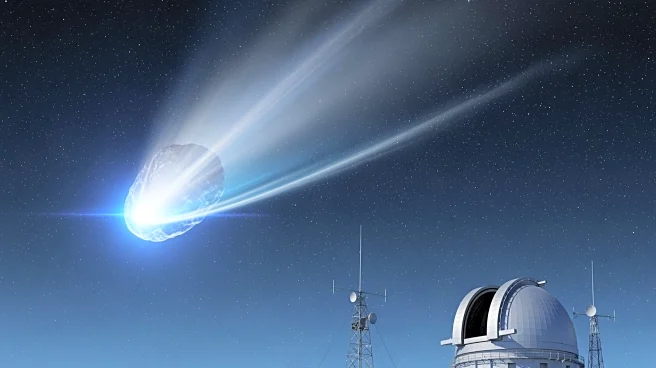
Interstellar comet 3I/ATLAS is set to make its closest approach to Earth on December 19, 2025, at a distance of approximately 270 million kilometers. This event marks a significant opportunity for scientific
observation as the comet, which originated from outside our solar system, will be closely monitored by global observatories. The comet was first detected on July 1, 2025, by the ATLAS survey telescope in Chile. It is the third confirmed interstellar object to pass through our solar system, following 1I/ʻOumuamua and 2I/Borisov. The comet's high velocity and trajectory confirm its interstellar origin. Recent developments include X-ray observations by the Japan-led XRISM mission and ESA's XMM-Newton, providing new insights into the comet's composition.
Why It's Important?
The approach of 3I/ATLAS offers a rare opportunity to study an interstellar object in detail, potentially enhancing our understanding of the materials and processes involved in the formation of planetary systems beyond our own. The comet's unique trajectory and composition could provide valuable data on the differences and similarities between our solar system and others. The event also serves as a practical test for global tracking systems coordinated by the United Nations' International Asteroid Warning Network, which aims to improve techniques for monitoring celestial objects. This could have implications for future planetary defense strategies.
What's Next?
Following its closest approach to Earth, 3I/ATLAS will continue its journey through the solar system, passing near Jupiter in March 2026. Observations will continue into spring 2026, allowing scientists to track the comet's activity as it moves away from the Sun. The data collected during this period will contribute to ongoing research into interstellar objects and their characteristics. Additionally, the event will be used to refine tracking and observation techniques, which could be crucial for future encounters with similar objects.