






What's Happening?
The Ulster Museum in Belfast recently hosted a unique coronial investigation into the death of Ballymacombs More Woman, whose remains were discovered in a County Derry bog three years ago. This inquiry, structured like a modern coroner's investigation,
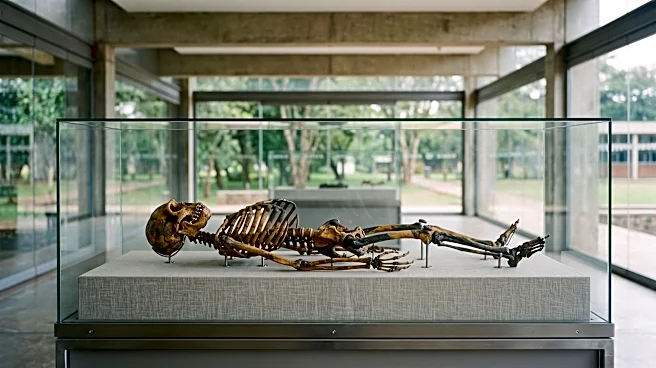
aimed to piece together the story of a young woman who was deliberately decapitated over 2,000 years ago during the Iron Age. Experts from across Europe, including researchers, museum professionals, and forensic specialists, participated in the examination of evidence. The investigation concluded that Ballymacombs More Woman was between 15 and 22 years old when she died from a bladed weapon inflicted from behind. Scientific analysis of her remains and associated artifacts provided insights into her diet, health, appearance, and the world she inhabited. While the exact circumstances of her death remain unknown, evidence suggests it may have been part of a ritualized killing or sacrifice, a practice documented among other bog body discoveries in Iron Age northwestern Europe.
Why It's Important?
This investigation is significant as it offers a rare and compelling glimpse into the beliefs, practices, and daily lives of people from the Iron Age. By applying modern forensic and investigative techniques to ancient remains, researchers can reconstruct historical narratives with unprecedented detail, bridging the gap between the distant past and the present. The case of Ballymacombs More Woman contributes to a broader understanding of Iron Age societies, particularly their cultural and religious practices, including the potential for ritual sacrifice. Her story, alongside other internationally renowned finds like Tollund Man, provides invaluable data for archaeologists, historians, and anthropologists, enriching our collective knowledge of human evolution and societal development. Furthermore, the public nature of this inquiry, involving various experts and the judiciary, highlights the interdisciplinary approach now common in archaeological research and its relevance to contemporary understanding.
What's Next?
The story of Ballymacombs More Woman will continue to inform new interpretations and exhibits at the Ulster Museum, particularly in the Early Peoples gallery. National Museums NI plans to ensure her story resonates long into the future, serving as a bridge from the Iron Age to the modern world. The extensive research program, which employed advanced scientific techniques such as micro-CT scanning, digital mapping, and 3D imaging, will also serve as a crucial resource for future academic research and learning. The collaborative effort involving multiple universities and institutions suggests ongoing interdisciplinary studies and publications are likely to emerge from this discovery. This case also sets a precedent for how ancient human remains can be investigated and presented to the public, fostering a deeper connection to historical narratives.
Beyond the Headlines
The investigation into Ballymacombs More Woman transcends a mere historical inquiry, touching upon profound ethical and cultural dimensions. By treating ancient remains with the rigor of a modern coronial investigation, it underscores a societal commitment to understanding and honoring past lives, regardless of the centuries that separate us. The effort to restore an understanding of her life, death, and place in history reflects a broader humanistic approach to archaeology, moving beyond mere artifact collection to narrative reconstruction. This process also highlights the evolving role of museums as not just repositories of objects, but as dynamic centers for research, interpretation, and public engagement, connecting academic findings with broader societal interest. The potential ritualistic nature of her death also invites deeper contemplation on ancient belief systems, the sacred, and the human condition across millennia.