



What's Happening?
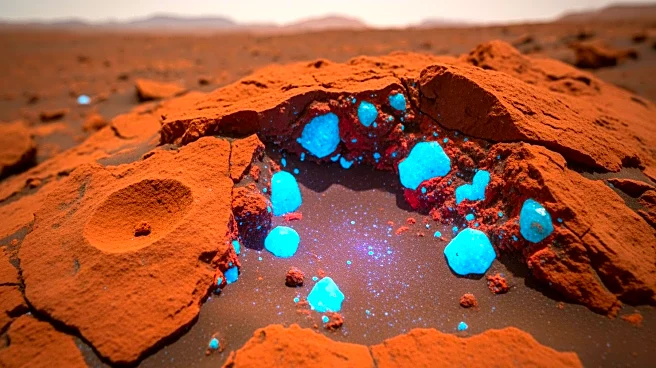
NASA's Perseverance rover has made a groundbreaking discovery on Mars by identifying tiny fluorescent gemstones within Martian pebbles. These gems, composed of corundum, are likely rubies or sapphires, according to the rover's analysis. The discovery was
made in a region outside the rim of Jezero Crater. Unlike Earth, where tectonic activity typically forms such gemstones, the Martian gems are believed to have been formed by meteorite impacts. This finding was presented by Ann Ollila from Los Alamos National Laboratory at the Lunar and Planetary Science Conference in Texas. The rover used its SuperCam instrument to analyze the rocks, revealing the presence of luminescent materials indicative of corundum.
Why It's Important?
The discovery of fluorescent gems on Mars is significant as it provides new insights into the planet's geological history and the processes that have shaped its surface. The presence of corundum suggests that meteorite impacts have played a crucial role in the formation of these gemstones, offering a different perspective from Earth's tectonic processes. This finding could influence future exploration strategies, as it highlights the potential for discovering other mineral deposits on Mars. Additionally, the discovery adds to the growing body of evidence that Mars has a complex geological history, which could have implications for understanding the planet's past habitability and the potential for life.
What's Next?
Future missions to Mars may focus on further exploring the areas around Jezero Crater to better understand the distribution and formation of these gemstones. Researchers may also seek to analyze the chemical composition of the gems more closely to determine their exact origins and the conditions under which they formed. This could involve deploying more advanced instruments or even returning samples to Earth for detailed study. The findings could also prompt a reevaluation of the mineralogical resources available on Mars, potentially influencing the planning of future manned missions and the development of in-situ resource utilization technologies.
Beyond the Headlines
The discovery of rubies and sapphires on Mars raises intriguing questions about the planet's potential for hosting valuable mineral resources. While the immediate scientific interest lies in understanding the geological processes at play, there could be long-term implications for space mining and the economic viability of Mars exploration. The presence of such gemstones might also inspire public interest and support for space exploration, as it adds an element of mystery and allure to the Red Planet. Ethically, the prospect of mining on Mars would need to be carefully considered, balancing scientific exploration with the preservation of the planet's natural state.