





What's Happening?
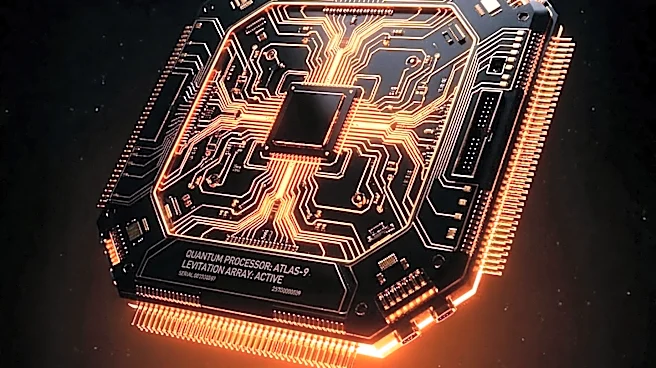
Physicists at the University of Cologne have made a significant step towards more error-resistant quantum computing by observing predicted quantum states in a material system promising for topological quantum computing. Their findings, published in Science
Advances, support a theoretical description of how superconductivity interacts with the surface of a topological insulator. Topological quantum computing is an approach designed to make information storage in quantum computing less prone to errors by utilizing special quantum states that are inherently more resistant to local disturbances. The team, led by professor Yoichi Ando, studied a Josephson junction, a structure consisting of two superconductors connected by a non-superconducting region. Using tunneling spectroscopy, they observed highly transmissive Andreev states, which form when electrons and holes interact at a superconducting junction. These states appeared across a range of charge-carrier densities and concentrated in specific regions when a magnetic field was applied, consistent with theoretical predictions.
Why It's Important?
This research is crucial for the advancement of quantum computing, particularly in addressing one of its most significant challenges: error correction. Current quantum computers are highly susceptible to noise and decoherence, limiting their practical applications. Topological quantum computing offers a potential solution by creating more robust qubits that are less affected by environmental disturbances. If successfully developed, this could lead to the creation of fault-tolerant quantum computers, which are essential for tackling complex problems in fields like drug discovery, materials science, and cryptography. The experimental validation of theoretical predictions strengthens the foundation for this promising approach, potentially accelerating the development of stable and scalable quantum technologies. This breakthrough could significantly impact the U.S. technology sector, fostering innovation and competitiveness in the global quantum race.
What's Next?
An important question remains regarding whether the observed states undergo the predicted closing and reopening of an energy gap, which would signal a transition to topological superconductivity. This transition is key to achieving quantum states protected against local disturbances. To confirm this, the researchers, including Dr. Jakob Schluck and Ella Nikodem, plan to improve the experiment's energy and time resolution. This next step is vital for demonstrating the topological phase transition in this system and moving closer to realizing robust topological qubits. Continued research in this area will focus on refining experimental techniques and further exploring the properties of topological insulators in conjunction with superconductors to unlock their full potential for quantum computing applications.
Beyond the Headlines
The pursuit of topological quantum computing represents a deeper scientific quest to harness exotic quantum phenomena for practical technological applications. The concept of Majorana zero modes, which topological superconductivity could enable, is not only a cornerstone for robust qubits but also a fascinating area of fundamental physics. The successful realization of such systems could open doors to entirely new paradigms of computation, potentially leading to breakthroughs that are currently unimaginable. This research highlights the intricate interplay between theoretical physics and experimental material science, where abstract concepts are brought to life in the lab. The long-term implications extend beyond computing, potentially influencing our understanding of quantum gravity and the fundamental nature of reality, as suggested by theoretical physicists exploring the simulation of a holographic universe with stable qubits.