
What's Happening?
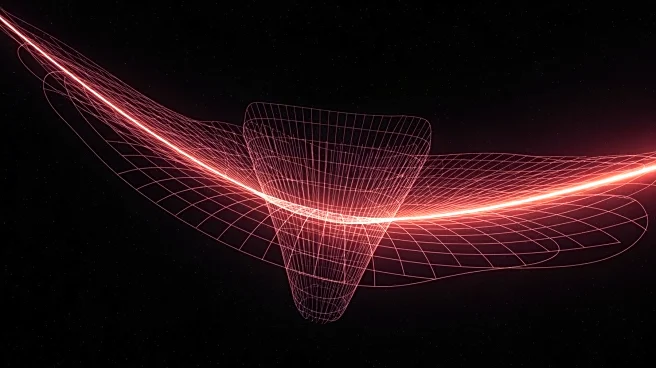
A recent discovery of a gravitational wave, designated GW250114, has provided scientists with a clearer signal than ever before, allowing for a more precise test of Albert Einstein's theory of general
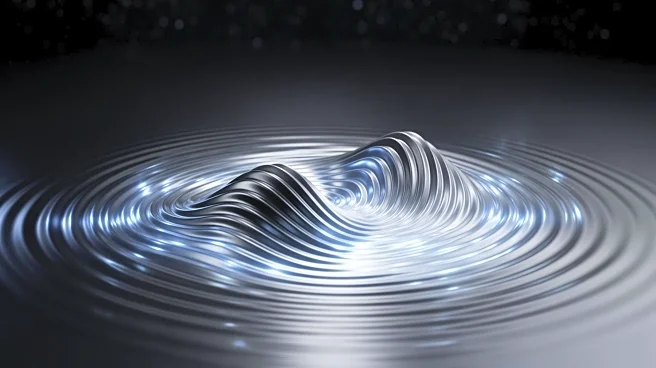
relativity. This wave was detected by the Laser Interferometer Gravitational-Wave Observatories (LIGO) in the United States on January 14, 2025, and was publicly announced in September 2025. The wave resulted from the collision of two black holes, creating ripples in space-time. The study, involving collaborations from LIGO, Virgo in Italy, and KAGRA in Japan, was published in Physical Review Letters. The signal's clarity allowed researchers to measure two distinct tones, which confirmed the predictions of general relativity. However, scientists remain open to the possibility that future signals might reveal deviations from Einstein's theory, potentially offering insights into unresolved phenomena like dark energy and dark matter.
Why It's Important?
This discovery is significant as it provides a robust test of general relativity, a cornerstone of modern physics. The ability to measure multiple tones from the gravitational wave signal allows for independent verification of the mass and spin of the resulting black hole, reinforcing the accuracy of Einstein's predictions. However, the scientific community is particularly interested in potential deviations from these predictions, which could indicate new physics beyond general relativity. Such findings could help bridge the gap between general relativity and quantum mechanics, addressing long-standing mysteries in physics. The research underscores the importance of international collaboration in advancing our understanding of the universe and highlights the potential for future discoveries that could reshape fundamental theories of gravity.
What's Next?
Researchers anticipate that future gravitational wave detections may not align perfectly with general relativity, offering opportunities to explore new theories of gravity. The scientific community is eager to identify any discrepancies that could point to quantum gravity effects, which are not currently explained by general relativity. As detection technology continues to improve, scientists hope to capture more detailed signals that could reveal these deviations. Such advancements could lead to a deeper understanding of the universe's fundamental forces and potentially guide the development of a unified theory that reconciles general relativity with quantum mechanics.
Beyond the Headlines
The implications of this discovery extend beyond testing Einstein's theory. It highlights the evolving capabilities of gravitational wave observatories and the potential for these tools to uncover new aspects of the universe. The research also emphasizes the importance of interdisciplinary collaboration in tackling complex scientific questions. As scientists continue to explore the boundaries of known physics, the findings from gravitational wave studies could influence a wide range of fields, from cosmology to particle physics, and inspire new theoretical frameworks that address the limitations of current models.