
What's Happening?
NASA has released its 2025 Annual Highlights of Results, showcasing significant scientific achievements conducted aboard the International Space Station (ISS). Over 750 investigations were carried out,
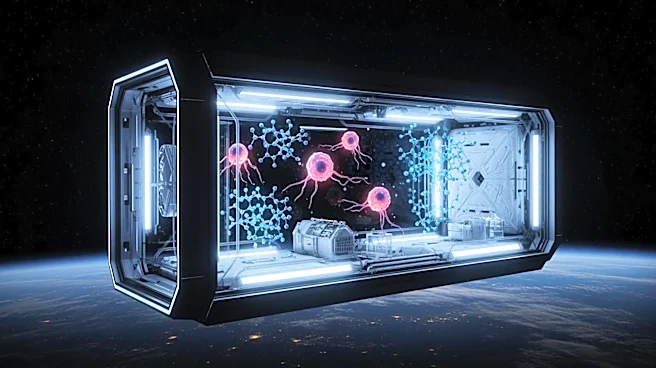
advancing knowledge in areas such as life in space, tissue engineering, and regenerative medicine. Notable projects include a robotic surgery demonstration in microgravity, which tested the feasibility of performing precise surgical tasks in space. Additionally, a study on synthetic bone graft materials showed promising results for bone growth, potentially aiding astronauts in long-duration missions. The research also explored the durability of materials exposed to space conditions, with findings that could enhance radiation shielding for future missions.
Why It's Important?
The research conducted on the ISS has far-reaching implications for both space exploration and terrestrial applications. The ability to perform robotic surgery in space could revolutionize medical care for astronauts on long missions, while advancements in synthetic bone grafts could improve healthcare on Earth. The study of materials' resistance to space conditions is crucial for developing safer and more efficient spacecraft. These scientific endeavors not only support NASA's goals for lunar and Martian exploration but also contribute to technological innovations that benefit society as a whole.
What's Next?
As NASA continues to explore the potential of the ISS as a research platform, future investigations will likely focus on further enhancing the safety and sustainability of space missions. The development of new technologies and materials will be critical for upcoming lunar missions under the Artemis program and eventual human exploration of Mars. Continued international collaboration and investment in space research will be essential to achieving these ambitious goals.
Beyond the Headlines
The research on the ISS also highlights the importance of international cooperation in advancing scientific knowledge. With contributions from over 110 nations, the ISS serves as a model for collaborative efforts in addressing global challenges. The findings from these investigations not only advance space exploration but also have the potential to drive innovation in various industries, from healthcare to materials science.