
What's Happening?
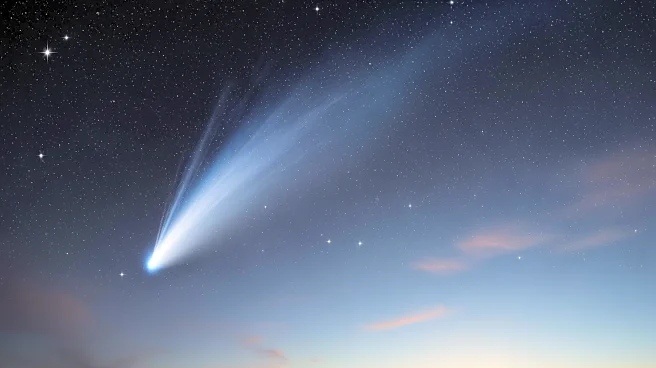
Comet C/2025 R3 (PanSTARRS) is anticipated to become the brightest comet of 2026, potentially outshining its predecessors. Discovered on September 8, 2025, by the Pan-STARRS 2 telescope in Hawaii, the comet is currently
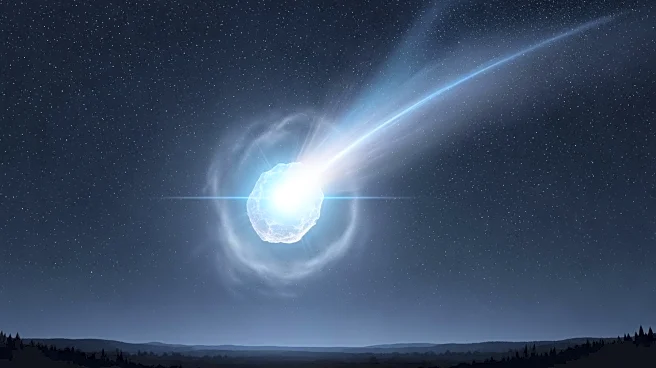
located around 216 million miles from Earth, between the orbits of Jupiter and Mars. It is a long-period comet originating from the Oort cloud, a distant spherical shell surrounding the solar system. As it approaches the inner solar system by late April 2026, its tail of gas and dust will reflect sunlight, increasing its brightness. This phenomenon, known as forward scattering, will make the comet visible to the naked eye in the Northern Hemisphere's predawn sky and in the Southern Hemisphere after sunset in May. The comet's brightness is predicted to reach a magnitude of 2.5, comparable to the brightest stars in the Cassiopeia constellation.
Why It's Important?
The appearance of Comet C/2025 R3 (PanSTARRS) offers a rare opportunity for both amateur and professional astronomers to observe a celestial event of significant brightness. Such events can enhance public interest in astronomy and provide valuable data for scientific research. The comet's visibility without the need for advanced equipment makes it accessible to a wide audience, potentially inspiring future generations of astronomers. Additionally, studying the comet's composition and behavior as it approaches the Sun can yield insights into the early solar system's conditions and the processes governing cometary dynamics.
What's Next?
As Comet C/2025 R3 (PanSTARRS) approaches its closest point to the Sun, astronomers will continue to monitor its trajectory and brightness. Observatories worldwide are likely to conduct detailed studies to understand its composition and the effects of solar radiation on its structure. Public interest is expected to grow as the comet becomes more visible, with educational institutions and astronomy clubs organizing viewing events. The comet's journey will be closely followed by both the scientific community and the general public, with updates on its visibility and scientific findings anticipated.