



What's Happening?
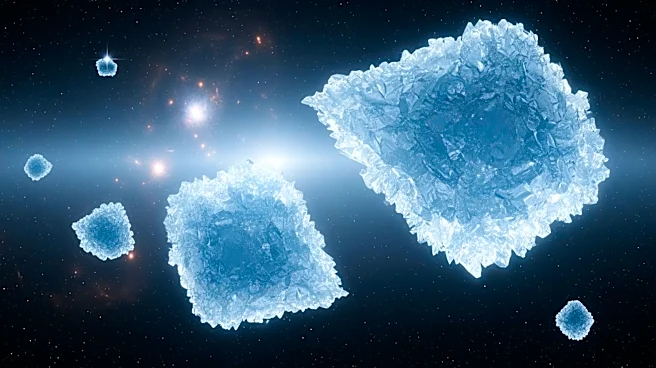
NASA's SPHEREx (Spectro-Photometer for the History of the Universe, Epoch of Reionization, and Ices Explorer) has successfully mapped the chemical signatures of interstellar ice in the Milky Way. The observation, released on April 15, 2026, highlights
the presence of water ice and polycyclic aromatic hydrocarbons in Cygnus X, a region known for active star formation. SPHEREx, launched on March 11, 2025, is designed to observe the sky in 102 different infrared wavelengths, providing detailed information about galaxies, stars, and planet-forming regions. The mission aims to understand the chemical processes that lead to the formation of water and other vital molecules in space, which are crucial for the development of life.
Why It's Important?
The findings from SPHEREx are significant as they enhance our understanding of the origins of water in the universe, which is essential for life. By mapping interstellar ice, NASA can trace the chemical pathways that lead to the formation of water and other life-supporting molecules. This research not only contributes to our knowledge of cosmic chemistry but also aids in understanding the distribution of water in the universe, including its presence in comets and on other celestial bodies. Such insights are crucial for future space exploration and the search for extraterrestrial life, as they provide clues about where life-supporting conditions might exist beyond Earth.