







What's Happening?
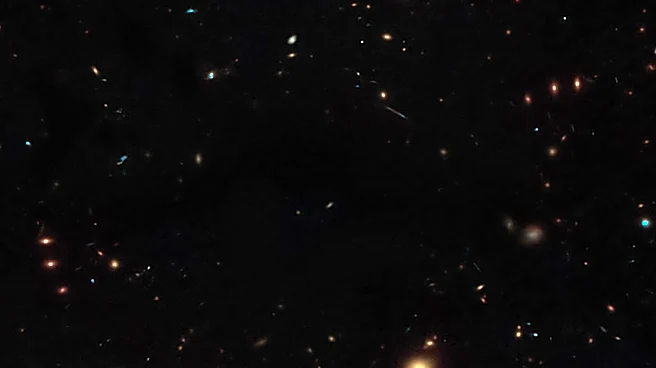
New simulations of El Gordo, one of the most massive and distant galaxy clusters observed, indicate that dark matter might interact with itself through collisions. The study, led by Riccardo Valdarnini, a former researcher in SISSA’s Astrophysics and Cosmology
group, found that the observed characteristics of El Gordo are best explained by a two-state self-interacting dark matter model. In this model, dark matter particles can collide and exchange energy through both elastic and inelastic scattering channels. These findings, published in The Astrophysical Journal, offer fresh clues regarding the nature of dark matter, a significant mystery in cosmology. However, the researchers emphasize that these results require further validation through the study of other merging galaxy clusters to confirm the self-interacting nature of dark matter.
Why It's Important?
The possibility of self-interacting dark matter represents a significant departure from the widely accepted Cold Dark Matter (CDM) model, which posits that dark matter particles interact only gravitationally. If dark matter particles can collide with each other, it would provide a new mechanism to explain certain astrophysical observations that are challenging to reconcile with the standard CDM model, such as the distribution of dark matter within galaxy halos. This discovery could lead to a fundamental revision of our understanding of dark matter's properties and its role in cosmic structure formation. Confirming self-interacting dark matter would open new avenues for theoretical physics and experimental searches, guiding the development of new detectors and observational strategies to probe these interactions. It could also help resolve discrepancies between simulations and observations of small-scale structures in the universe.
What's Next?
The next crucial step involves testing the self-interacting dark matter model against observations of other merging galaxy clusters. Researchers will need to conduct similar simulations and analyses on a broader sample of cosmic structures to determine if the model consistently explains their properties. Further theoretical work will also be necessary to refine the two-state self-interacting dark matter model and explore its implications for particle physics. If confirmed, these findings could spur the development of new experimental techniques designed to detect the subtle interactions between dark matter particles. The scientific community will closely scrutinize future studies to validate or refute this intriguing hypothesis, potentially leading to a breakthrough in our understanding of the universe's dominant form of matter.
Beyond the Headlines
The concept of self-interacting dark matter challenges the long-held assumption of dark matter's purely gravitational nature, pushing the boundaries of our cosmological models. This research highlights the iterative process of scientific discovery, where new observations and advanced simulations can lead to revisions of fundamental theories. The implications extend beyond astrophysics, potentially influencing particle physics by suggesting new properties for hypothetical dark matter particles. If dark matter is indeed self-interacting, it could mean that the universe is even more complex and dynamic than previously imagined, with subtle interactions playing a crucial role in shaping cosmic structures. This ongoing quest for dark matter's true nature underscores humanity's persistent drive to unravel the universe's deepest secrets and refine our understanding of reality.