




What's Happening?
Some physicists are questioning the existence of dark energy, a concept central to the Standard Model of Cosmology, which posits that dark energy accounts for approximately 70% of the universe's energy content and drives its accelerating expansion. While
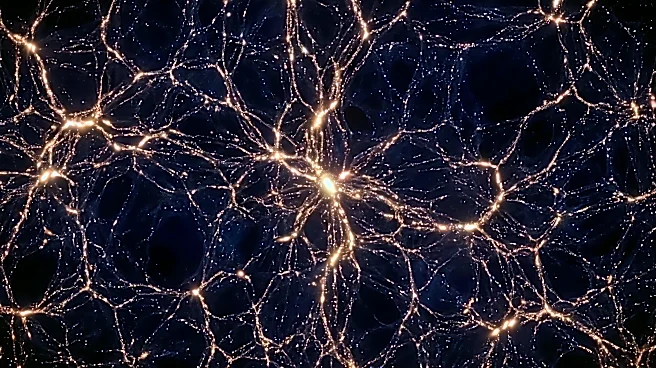
dark matter is detectable through its gravitational effects, dark energy is harder to conceptualize, often described as a property of space itself with negative pressure. However, a niche area of cosmology research suggests that the observed accelerated expansion might stem from a misunderstanding of gravity and the assumptions made in General Relativity. Hayley Macpherson, a General Relativity and cosmology researcher at the University of Chicago, notes that the assumption of a homogeneous and isotropic universe, while valid for the early universe, may not hold true for the clumpy, evolved universe we see today. Prof. David Wiltshire at the University of Canterbury argues that these assumptions are so far off base that they lead to an incorrect view of the universe, suggesting that the expansion rate depends on the 'clumpiness' of the universe and the varying passage of time due to gravity. This perspective proposes that the universe's expansion only appears to be accelerating because we are observing voids where expansion seems faster, rather than areas with galaxies where it appears slower, potentially eliminating the need for dark energy.
Why It's Important?
The debate over dark energy's existence challenges the foundational principles of the Standard Model of Cosmology, which has been remarkably successful in predicting most observations for the past 25 years. If dark energy does not exist, or if its properties are fundamentally misunderstood, it would necessitate a significant revision of our cosmic models and a deeper understanding of gravity. This could resolve several 'oddities' in the Standard Model, such as the Hubble tension (discrepancies in measuring the universe's expansion rate) and the quasar dipole anomaly (inconsistencies in the distribution of bright radio sources). The implications are profound, as dark energy is currently invoked to explain the universe's accelerating expansion. A re-evaluation could lead to new theories of gravity or a more complex understanding of spacetime, impacting our predictions for the universe's ultimate fate. The ongoing research, including simulations by Macpherson that incorporate more complex descriptions of gravity, aims to determine if the simplifying assumptions in current models are indeed negligible or if they mask a more fundamental truth about the cosmos.
What's Next?
Researchers like Hayley Macpherson are actively building simulations of the universe based on more complex descriptions of gravity, aiming to remove some of the simplifying assumptions typically applied to General Relativity. While initial results from these simulations suggest that the effects of these assumptions might be small, more work is needed to definitively confirm this. The Dark Energy Spectroscopic Instrument (DESI) and the European Space Agency's Euclid mission are gathering unprecedented amounts of data to map the large-scale structure of the universe and test predictions of the minimal cosmological model with greater precision. These observations could reveal 'cracks in the facade' where the simplest model's predictions do not match observations, providing clues for going beyond the current understanding. Recent findings from DESI and the Dark Energy Survey also support the theory that dark energy might be changing over time, suggesting it may not be a constant. This would further challenge the Standard Model and prompt new theoretical developments.
Beyond the Headlines
The questioning of dark energy's existence highlights a crucial aspect of scientific progress: the continuous challenge and refinement of established theories. It underscores that even widely accepted models, like the Standard Model of Cosmology, are subject to scrutiny and potential revision as new data and theoretical insights emerge. The debate also touches upon the philosophical implications of our scientific assumptions, particularly the assumption of homogeneity and isotropy in the universe. If our perception of cosmic acceleration is an artifact of these assumptions, it implies a deeper, more intricate reality that we are only beginning to uncover. This scientific humility, acknowledging that 95% of the universe's composition (dark matter and dark energy) remains unknown, drives innovation and encourages exploration of alternative explanations, even those that seem 'preposterous' at first glance. The pursuit of these answers will not only reshape physics but also our fundamental understanding of existence.