
What's Happening?
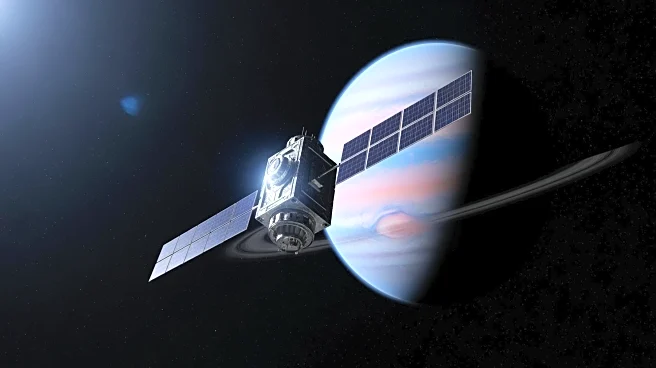
NASA successfully launched its newest planet-observing satellite, Pandora, aboard a SpaceX Falcon 9 rocket from Vandenberg Space Force Base in California. The launch took place on January 11, 2026, at 5:44
a.m. PST. Pandora is designed to study at least 20 known exoplanets, focusing on the composition of their atmospheres, including the presence of hazes, clouds, and water. Alongside Pandora, the rocket also carried two CubeSats sponsored by NASA: the Star-Planet Activity Research CubeSat (SPARCS) and the Black Hole Coded Aperture Telescope (BlackCat). These CubeSats will contribute to research in their respective fields, enhancing our understanding of space phenomena.
Why It's Important?
The launch of Pandora represents a significant advancement in the study of exoplanets, which are planets outside our solar system. By analyzing the atmospheres of these distant worlds, scientists hope to gain insights into their potential habitability and the presence of life-supporting conditions. This mission underscores NASA's commitment to exploring the universe and expanding our knowledge of planetary systems. The data collected by Pandora could have profound implications for future space exploration and the search for extraterrestrial life, potentially influencing scientific priorities and funding in the field of astrophysics.
What's Next?
Following the successful launch, Pandora will begin its mission to observe and analyze the atmospheres of selected exoplanets. The data gathered will be processed and studied by scientists to draw conclusions about the atmospheric conditions of these distant worlds. The findings could lead to further missions aimed at exploring exoplanets with promising conditions for life. Additionally, the CubeSats SPARCS and BlackCat will conduct their respective research, contributing to a broader understanding of space phenomena and potentially leading to new discoveries in astrophysics.