





What's Happening?
A new report titled 'Powering Affordability: Why America Should Invest in the Homes We Already Have,' authored by Groundswell and Groundwork Collaborative, argues for a stronger link between housing and energy policy in the U.S. The report highlights
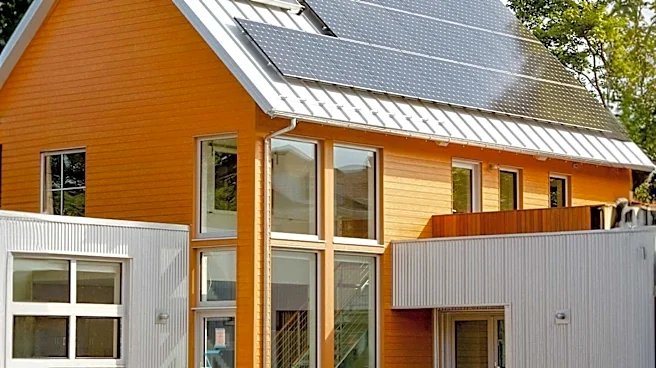
that nearly half of American homes were built before 1980, and 49 million households have at least one critical home repair need, often disproportionately affecting lower-income families. These issues prevent homes from fully utilizing distributed energy resources like solar panels and batteries. The authors contend that investing in home repair and energy efficiency at scale is crucial for unlocking the full potential of distributed energy resources, demand response, and virtual power plants. They propose considering the home as a 'piece of energy infrastructure' and suggest that the cost of fixing all U.S. households is a fraction of the projected $1.4 trillion investment in new energy infrastructure by investor-owned utilities through 2030.
Why It's Important?
This report underscores a critical, often overlooked, aspect of the U.S. energy transition: the foundational role of existing housing stock. By linking housing and energy policy, the U.S. could achieve more effective and equitable energy outcomes. The current state of many American homes, particularly those of lower-income families, creates a barrier to adopting energy-efficient technologies and participating in distributed energy programs. Addressing these structural issues first could significantly reduce overall energy consumption, as it is often cheaper to save energy than to generate more. This approach could also alleviate the disproportionate energy burden on low-income households, who spend a larger percentage of their income on energy bills. Furthermore, integrating residential energy efficiency into electric system planning could defer costly grid investments and enhance grid stability by reducing peak demand.
What's Next?
The report proposes several policy recommendations, including establishing a federally capitalized revolving fund to offer low-cost loans and grants for home repairs and energy efficiency upgrades. This fund could be combined with utility incentives, state rebates, and private investment. The authors also suggest that federal and state policies should put a market value on peak demand reduction and incorporate residential energy efficiency into electric system planning. Another interesting recommendation is allowing data center developers to procure a portion of their energy needs through investments in residential energy efficiency. These proposals aim to shift how energy efficiency is planned, measured, and compensated, requiring changes in regulatory frameworks and utility practices to recognize the full value of residential energy improvements.
Beyond the Headlines
The report's emphasis on the home as 'energy infrastructure' represents a paradigm shift in how policymakers and utilities might view residential properties. It highlights the ethical dimension of energy policy, arguing that neglecting home repairs and energy efficiency exacerbates energy poverty and inequality. The idea of data center developers investing in residential energy efficiency to meet their own energy needs presents an innovative model for private-public partnerships in the energy sector. This approach could create new revenue streams for homeowners and incentivize broader adoption of energy-saving measures. However, the report also cautions that critical home repairs, while necessary, do not directly offer measurable grid benefits and should be funded separately to avoid passing these costs onto utility ratepayers, ensuring a fair distribution of financial burdens.