
What's Happening?
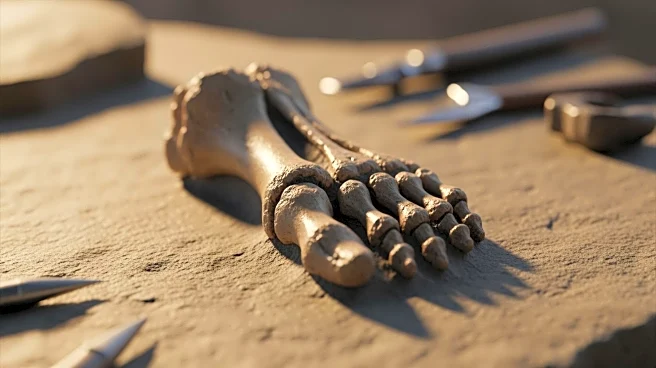
An international team of researchers, led by Dr. Jesse Martin from La Trobe University, has conducted a new analysis of the Little Foot fossil, one of the most complete hominin fossils ever discovered.
The study, published in the American Journal of Biological Anthropology, challenges previous classifications of the fossil, suggesting it may not belong to any known species. Little Foot, formally known as StW 573, was discovered in the Sterkfontein Caves near Johannesburg, South Africa, a site renowned for its rich hominin fossil record. The fossil was initially thought to belong to Australopithecus prometheus, a species proposed in 1948, but the new study indicates significant anatomical differences that suggest it could represent a previously unidentified human relative. The research highlights unique features in the skull that differ from both A. prometheus and A. africanus, suggesting a more complex picture of early human evolution in southern Africa.
Why It's Important?
The potential reclassification of Little Foot as a new species could significantly alter the understanding of human evolution, particularly in southern Africa. This region is already known for its diverse hominin fossils, and the addition of another species would suggest a more intricate evolutionary history than previously thought. The findings challenge the traditional view of a linear progression in human evolution, instead supporting a model where multiple hominin species coexisted and evolved in parallel. This complexity could provide insights into how different lineages adapted to changing environments and may influence current perspectives on human diversity and survival. The study underscores the importance of continued research and excavation in the region, as each new discovery has the potential to reshape the narrative of human ancestry.
What's Next?
While the researchers have not formally named a new species, they suggest that the honor should go to the team that excavated and analyzed Little Foot over the past two decades. Further studies are likely to focus on more detailed comparisons with other fossils and additional dating methods to better understand Little Foot's place in the human family tree. The ongoing debate and research may lead to a formal reclassification, which would require consensus within the scientific community. Additionally, future excavations in the Sterkfontein Caves and surrounding areas may uncover more fossils that could provide further evidence of the region's complex evolutionary history.
Beyond the Headlines
The discovery of a potential new species raises questions about the criteria used to define species in the fossil record. It highlights the challenges of interpreting incomplete fossil evidence and the need for advanced technologies, such as 3D scanning, to uncover subtle anatomical differences. The study also prompts a reevaluation of the role of southern Africa in human evolution, suggesting it was a hotspot for hominin diversity and adaptation. This could have implications for understanding the evolutionary pressures that shaped early human ancestors and their eventual spread across the globe.