




What's Happening?
The Society of Vertebrate Paleontology (SVP), an international scientific organization, has expressed deep concern regarding Fort Hays State University's (FHSU) announced closure of the Sternberg Museum of Natural History and reports of the university
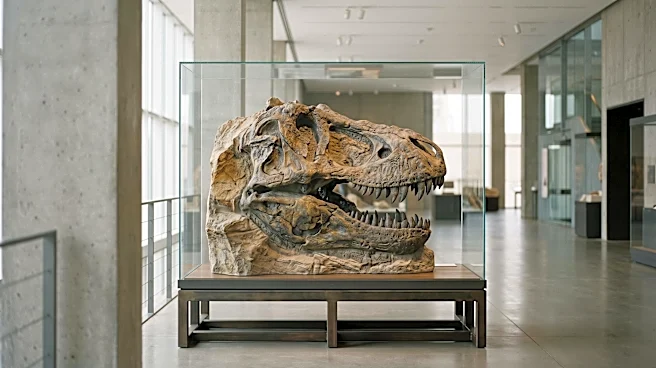
consulting with an auction house for its collections. The SVP emphasizes that engaging a commercial firm for museum holdings is incompatible with academic integrity, professional museum ethics, and responsible stewardship of scientific collections. They highlight that the Sternberg's own Collections Policy mandates a 'fiduciary responsibility' to preserve collections 'in perpetuity for the common good' and explicitly states that deaccessioned natural history specimens 'may never be transferred from public to private ownership.' This policy also protects type specimens and significant specimens from being removed from public trust by sale. The SVP points out that many specimens, including 37 holotype specimens, are legally protected under the U.S. Paleontological Resources Preservation Act, especially those collected from federal public lands, and cannot be lawfully sold or transferred to commercial ownership.
Why It's Important?
The potential commercial liquidation of the Sternberg Museum's collections poses a significant threat to scientific research and public trust. The collections, assembled over generations, hold immense scientific value beyond individual specimens, encompassing provenance, locality data, associations, preparation histories, and research records. Dispersing these into private hands would result in a permanent loss of scientific value for the people of Kansas and the global scientific community. The Sternberg collections are not limited to paleontology; they include pivotal botanical and biological assets, such as the Elam Bartholomew Herbarium, a highly utilized mammalogy collection, and major ichthyology and herpetology depositories for the Great Plains. Removing specimens from permanent collections could disrupt ongoing research projects, affect students' academic careers, and undermine the integrity and reproducibility of published science, as many paleontological journals require permanent accessibility of fossils for research validation.
What's Next?
The Society of Vertebrate Paleontology is urging FHSU to abandon any consideration of commercial dealings with the Sternberg Museum collections. They recommend that FHSU uphold its legal and ethical obligations, maintain transparency regarding past and future discussions about the collections, and strive to preserve the collection's integrity as a whole. The SVP has offered to provide scientifically responsible legal guidance and technical expertise to help FHSU find a legal, ethical, and preservation-focused solution. If FHSU determines it can no longer maintain the museum, its policy directs that deaccessioning should prioritize transfer or exchange with another tax-exempt museum or educational institution to ensure continued research, educational, or exhibition purposes, rather than commercial sale.
Beyond the Headlines
This situation highlights a broader ethical and legal debate surrounding the stewardship of scientific collections held in public trust. The potential sale of these collections to private entities raises questions about the long-term accessibility of invaluable scientific data for future generations of researchers and the public. It underscores the tension between institutional financial pressures and the enduring public and scientific value of natural history collections. The case could set a precedent for how universities and museums manage their assets, particularly those with significant scientific and cultural heritage. The SVP's intervention emphasizes the critical role of professional scientific organizations in advocating for the preservation of such resources and upholding ethical standards in the scientific community.