








What's Happening?
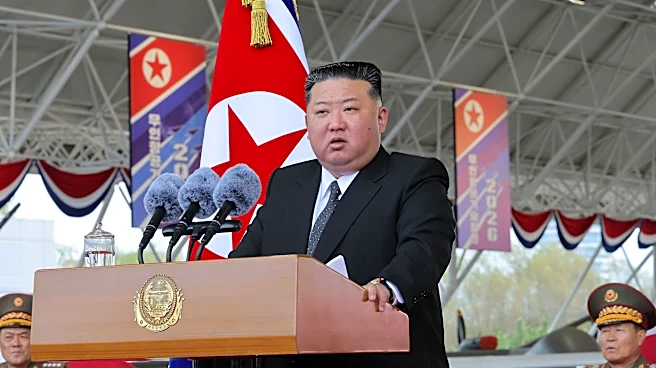
Award-winning cartoonist Keum Suk Gendry-Kim's latest work, 'My Friend Kim Jong Un,' delves into the pervasive influence of North Korea on Korean society. The book, a 244-page softcover volume, uses black and white, and blue and gold comics to explore
the psychological complexities of a nation divided. Gendry-Kim, whose home and studio are an hour from Seoul, has a direct view of North Korea, experiencing the daily sounds of artillery fire, helicopters, and sirens from a nearby military base. This proximity underscores the constant presence of the dictatorship and its nuclear capabilities in daily life. The book combines broad historical overviews with personal experiences, examining the life of the supreme leader from his birth and international education to his hobbies and relationships. It also incorporates interviews with former South Korean president Moon Jae-in, North Korean defectors, researchers, journalists, and even Kim Jong Un’s former chef.
Why It's Important?
This work is significant as it offers a unique perspective on the ongoing division of Korea and the psychological impact it has on its people. While Korean culture gains global popularity, a deep-seated unease and anxiety persist in South Korea due to the distrust and anger stemming from one culture split into two distinct societies. Gendry-Kim's exploration of Kim Jong Un's life aims to find commonalities and make sense of the daily fear experienced by many. The book serves as a cautionary tale about the making of a dictator, a theme that the publisher, D & Q, suggests is increasingly relevant in Western contexts. By weaving personal accounts with historical and political analysis, the book provides a nuanced understanding of a complex geopolitical situation and its human cost.
Beyond the Headlines
Beyond its immediate narrative, 'My Friend Kim Jong Un' touches upon deeper ethical and cultural dimensions. The book's attempt to humanize a figure often demonized in Western media, while still acknowledging his role as a dictator, prompts readers to consider the complexities of leadership and the factors that shape such individuals. It also highlights the enduring trauma of national division and the struggle for identity in a region constantly under the shadow of political tension. The inclusion of diverse perspectives, from a former president to defectors and even Kim's former chef, suggests a multifaceted approach to understanding a figure and a nation that are often viewed through a singular, often hostile, lens. This approach encourages a more empathetic, albeit critical, engagement with the subject matter, fostering a deeper understanding of the human element within geopolitical conflicts.