






What's Happening?
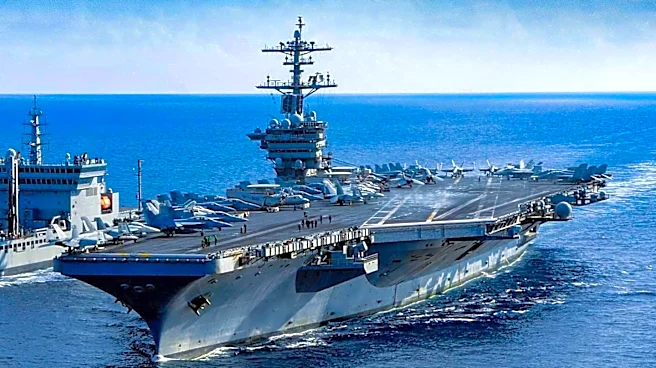
The USS Saratoga (CV-60), a Forrestal-class supercarrier, had a distinguished career from 1956 to 1994, playing a crucial role in U.S. naval power projection during the Cold War and the Gulf War. The carrier, weighing 81,101 tons and measuring 1,067 feet,
was equipped with an angled flight deck allowing for simultaneous aircraft launch and recovery. It was powered by eight Babcock & Wilcox boilers and four Westinghouse geared turbines, achieving speeds up to 33 knots. The Saratoga's air wing typically comprised about 90 aircraft, armed with various missiles and bombs. Throughout its service, the Saratoga deployed to volatile regions like the Mediterranean, tracked Soviet naval and air power, participated in NATO exercises, and enforced no-fly zones. Notable deployments included seven line periods at 'Yankee Station' during the Vietnam War, where its aircraft flew thousands of combat missions and shot down three enemy MiGs. The carrier also played a role in forcing the hijackers of the Achille Lauro to land in Sicily and conducted strikes against targets in Libya in the mid-1980s. During Operation Desert Storm, the Saratoga operated primarily in the Red Sea, launching 11,000 sorties and delivering over 4 million pounds of ordnance. Despite Saddam Hussein's claims of its sinking, the Saratoga remained operational, though it did experience a Scud missile fired in its general direction that missed by over 100 nautical miles.
Why It's Important?
The USS Saratoga's extensive service highlights its significance as a symbol of American air power and naval projection during a critical period of global geopolitics. Its participation in major conflicts like the Vietnam War and the Gulf War underscores the U.S. Navy's capability to deploy substantial military force globally. The carrier's technological advancements, such as the angled flight deck, revolutionized naval aviation and set standards for future aircraft carrier design. The Saratoga's missions, from monitoring adversaries to enforcing no-fly zones, demonstrate the multifaceted role of aircraft carriers in maintaining international stability and protecting U.S. interests. The sheer volume of ordnance delivered and combat missions flown during Desert Storm illustrates the decisive impact such vessels can have in modern warfare. Furthermore, the carrier's ability to operate effectively in contested environments, as evidenced by its continued operations despite enemy claims and attacks, reinforced its strategic value and the resilience of U.S. naval forces. The legacy of the Saratoga, with its anchors now on the USS Harry S. Truman, symbolizes the continuity of naval tradition and the enduring importance of carrier strike groups in U.S. defense strategy.
What's Next?
While the USS Saratoga was decommissioned in 1994 and subsequently scrapped by 2019, its operational history continues to inform naval strategy and technological development. The lessons learned from its nearly four decades of service, including its performance in various combat and peacetime operations, contribute to the ongoing evolution of aircraft carrier design, air wing composition, and naval tactics. Future naval planning will likely draw upon the experiences of carriers like the Saratoga to adapt to emerging threats and technological advancements. The U.S. Navy continues to invest in next-generation aircraft carriers, such as the Gerald R. Ford class, which build upon the foundational principles established by earlier supercarriers like the Saratoga. These new carriers aim to enhance operational efficiency, reduce manning requirements, and integrate advanced technologies, reflecting a continuous effort to maintain naval superiority. The strategic importance of carrier strike groups, exemplified by the Saratoga's career, remains a cornerstone of U.S. defense policy, ensuring global reach and power projection capabilities for decades to come.
Beyond the Headlines
The story of the USS Saratoga extends beyond its military achievements, touching upon broader themes of national identity, technological progress, and the human cost of conflict. The carrier served as a floating city, housing thousands of sailors and airmen, whose lives were shaped by their service aboard the vessel. Incidents like the ferry boat accident off Haifa, which resulted in the loss of 21 crewmembers, highlight the inherent dangers faced by military personnel even outside of direct combat. The Saratoga's role in various international incidents, such as the Achille Lauro hijacking, also underscores the complex and often unpredictable nature of global security challenges. The decision to scrap the Saratoga after attempts to convert it into a museum ship failed reflects the economic and logistical realities of preserving such massive vessels, yet its legacy lives on through its anchors on the USS Harry S. Truman. This continuity symbolizes the enduring spirit of naval service and the historical connection between generations of warships. The Saratoga's journey from a cutting-edge supercarrier to a dismantled relic offers a poignant reflection on the lifecycle of military technology and the constant evolution of defense capabilities.