



What's Happening?
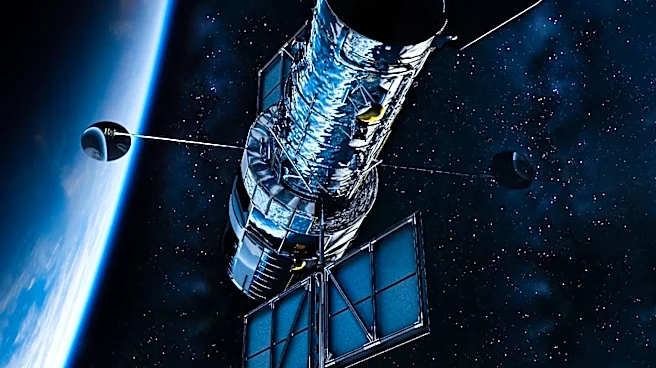
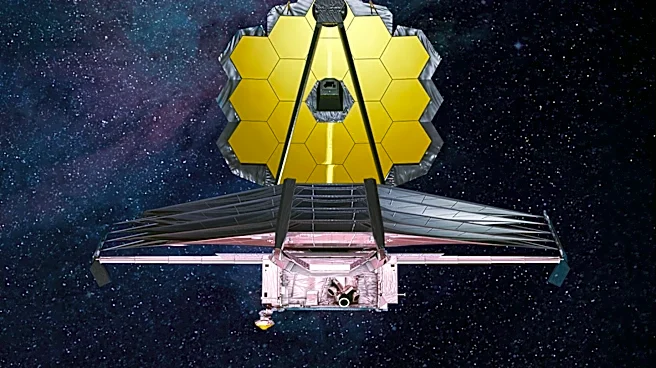
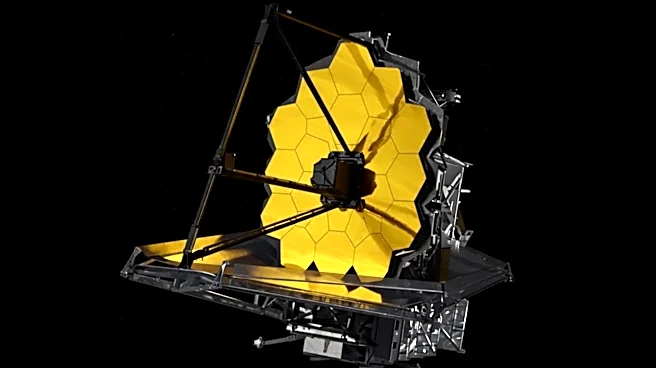
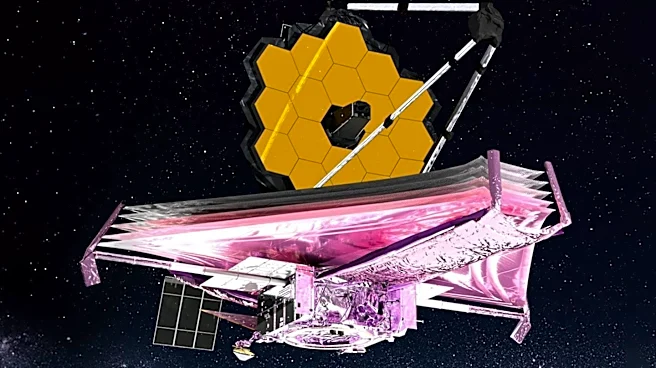
Scientists at the University of Arizona, led by assistant astronomer Brittany Miles, have made the first direct confirmation of variable water clouds on a celestial body outside our solar system. Using the James Webb Space Telescope, their team observed
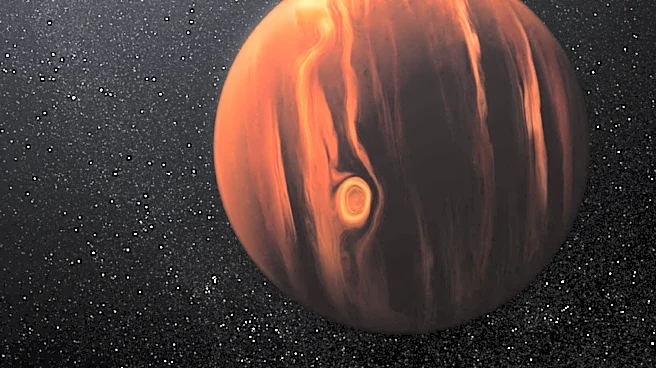
WISE 0855, the coldest known brown dwarf, for 11 hours, collecting a spectrum of its light every 15 minutes. This detailed time-series portrait revealed that the brown dwarf's atmosphere is influenced by two simultaneous processes: water clouds at high altitudes that change thickness as the object rotates, and deep chemical gases brought upward by convection from below. The study, published in The Astrophysical Journal, highlights the telescope's ability to distinguish these atmospheric components, a feat previously impossible with older instruments. WISE 0855, approximately twice Jupiter's mass and similar in size, behaves much like a free-floating giant planet, offering insights into planetary atmospheres.
Why It's Important?
This discovery is significant because it demonstrates that the fundamental physics governing convection, clouds, and chemistry on gas giants like Jupiter are universal, extending to distant, free-floating worlds. The ability to observe these atmospheric changes in real-time, molecule by molecule, provides a powerful new tool for understanding planetary science. This research has implications for the study of gas giant exoplanets, which astronomers are now beginning to investigate in earnest with the James Webb Space Telescope. By understanding the atmospheric dynamics of brown dwarfs, scientists can develop more accurate models for exoplanet atmospheres, enhancing our search for and characterization of potentially habitable worlds. The findings also underscore the advanced capabilities of the James Webb Space Telescope in unraveling complex astrophysical phenomena.
What's Next?
Brittany Miles plans to conduct more baseline observations with the James Webb Space Telescope to further detail WISE 0855's rotation and the three-dimensional nuances of its atmospheric movement. These additional observations will help refine current models and provide a more comprehensive understanding of how weather patterns develop and evolve on such distant objects. The success of this study is expected to encourage similar investigations into other brown dwarfs and exoplanets, pushing the boundaries of atmospheric characterization. The insights gained from WISE 0855 will contribute to a broader understanding of planetary formation and evolution, potentially informing future missions and observational strategies aimed at discovering and studying exoplanets with Earth-like characteristics.
Beyond the Headlines
The study's findings challenge the traditional distinction between brown dwarfs and planets, suggesting a spectrum of behaviors rather than a rigid boundary. The observation that basic physics and chemistry apply across diverse celestial bodies, from Jupiter to a cold, free-floating world seven light-years away, reinforces the idea of universal scientific principles. This research also highlights the collaborative nature of scientific discovery, building upon foundational work by theorists like Mark Marley. The ability to observe and understand these complex atmospheric processes in real-time represents a significant leap in our capacity to explore and comprehend the universe, potentially leading to new theoretical frameworks for planetary science and astrobiology.