


What's Happening?
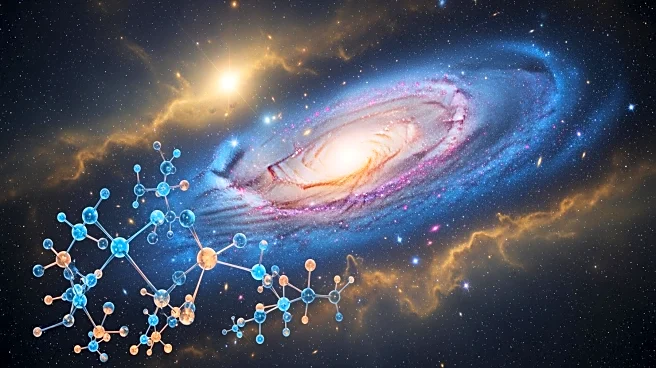
The James Webb Space Telescope (JWST) has revealed a remarkable abundance of organic molecules in the ultra-luminous infrared galaxy IRAS 07251-0248. Using advanced spectroscopic observations, researchers detected a variety of small organic molecules,
including benzene, methane, and acetylene, as well as the methyl radical, which was observed outside the Milky Way for the first time. These findings suggest a complex chemical environment in the galaxy's nucleus, which is obscured by gas and dust. The study highlights the role of cosmic rays in fragmenting carbon-rich dust grains, releasing these molecules into the gas phase.
Why It's Important?
This discovery is significant for understanding the chemical evolution of galaxies and the potential for prebiotic chemistry in space. The presence of these organic molecules could provide insights into the processes that lead to the formation of more complex organic compounds, which are essential for life. The findings also demonstrate the capabilities of the JWST in exploring previously hidden regions of the universe, offering new opportunities for research in astrochemistry and the origins of life.
What's Next?
Further studies using the JWST and other telescopes will likely focus on exploring similar galaxies to understand the prevalence and distribution of organic molecules in the universe. Researchers may also investigate the potential for these molecules to contribute to the formation of life-supporting compounds. The ongoing analysis of data from the JWST will continue to shed light on the chemical processes occurring in extreme environments, enhancing our understanding of the universe's complexity.