





What's Happening?
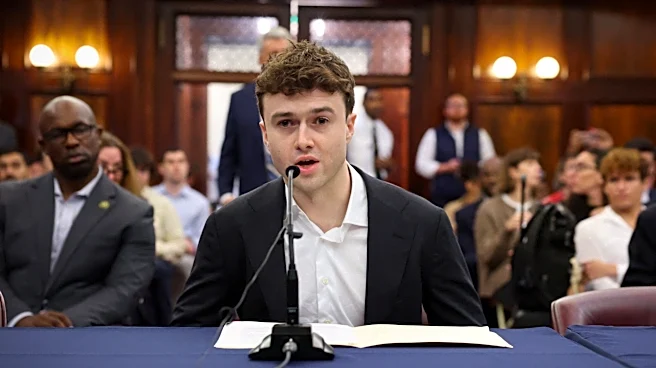
During a New York City Council hearing, three former AI lab researchers, Jacob Coxon (formerly of OpenAI and Anthropic), Daniel Kokotajlo (formerly of OpenAI), and Alex Turner (formerly of Google DeepMind), warned that humanity risks losing control of advanced
AI systems, potentially leading to human extinction. Coxon stated it's 'more likely than not that humanity loses control to these AIs.' The hearing, chaired by Speaker Julie Menin, also included policy staff from OpenAI, Anthropic, Google, and Meta, who appeared after being warned of subpoenas. The council is considering 10 bills to regulate AI in the city, including one that would require third-party validation and a human shutdown mechanism for any AI model marketed, sold, or deployed in NYC, with a $25,000 civil penalty for non-compliance. Other proposed bills address reporting AI violations, allowing New Yorkers to sue AI providers for foreseeable harm, and mandating incident reporting for city contractors using AI.
Why It's Important?
The testimony from former AI researchers underscores growing concerns within the AI community about the rapid, unregulated development of advanced AI and its potential catastrophic risks. This hearing in New York City highlights a significant push at the local government level to establish regulatory frameworks for AI, in the absence of comprehensive federal guidelines. The proposed legislation, particularly the requirement for third-party validation and human shutdown mechanisms, could set a precedent for how cities and states approach AI governance. Such regulations could impact AI companies by increasing compliance costs and potentially slowing down development, especially for those operating in or selling to NYC. The debate also brings to light the differing perspectives between AI developers, who often prioritize rapid innovation, and safety advocates, who emphasize the need for robust safeguards and ethical considerations.
What's Next?
The New York City Council will continue to deliberate on the proposed AI regulatory bills. If passed, these bills could significantly alter how AI models are developed, deployed, and used within the city, potentially influencing other municipalities and states to adopt similar measures. The subpoena issued to SpaceXAI, which did not appear at the hearing, indicates the council's intent to enforce its regulatory authority and gather information from all relevant AI entities. The call for 'smart regulation' by Anthropic's Logan Graham and a 'comprehensive' federal framework by Google's Alice Friend suggests that AI companies are open to regulation but prefer a unified national approach rather than a patchwork of local rules. The ongoing discussions will likely shape the future of AI governance, balancing innovation with safety and accountability, and could prompt federal action to establish a more consistent regulatory landscape.
Beyond the Headlines
The NYC Council hearing and the researchers' warnings touch upon profound philosophical and existential questions surrounding artificial intelligence. The concern about humanity losing control to AI systems, and the potential for 'human extinction,' moves beyond mere technological risk to a fundamental re-evaluation of humanity's relationship with its creations. The 'move fast and fix things later' startup mentality, criticized by former researcher Jacob Coxon, highlights a cultural clash between Silicon Valley's ethos and the cautious approach advocated by safety experts. The discussion also brings to the forefront the ethical responsibilities of AI developers and the role of government in safeguarding society from unforeseen technological consequences. This debate is not just about regulating a new technology; it's about defining the future trajectory of human civilization in an era where machines are increasingly capable of autonomous action and decision-making.