


What's Happening?
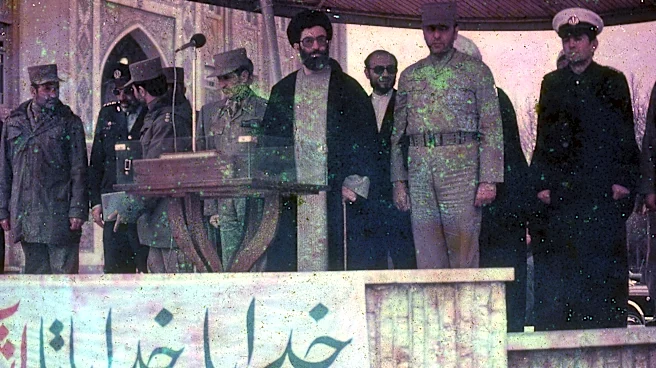
Fareed Zakaria's latest documentary special delves into the historical trajectory of Iran's nuclear program, revealing a surprising period following the 1979 Islamic Revolution. Contrary to common assumptions, Iran's new leadership, under Ayatollah Ruhollah
Khomeini, initially rejected atomic power, including nuclear weapons. After Khomeini's return from exile and the establishment of the Islamic Republic, there was a concerted effort to dismantle elements associated with the Shah's regime, which included his nuclear program. This historical detail challenges the widespread belief that the Islamic Republic immediately pursued nuclear weapons upon inheriting the Shah's nuclear infrastructure. The documentary, titled 'Iran and the bomb, a Fareed Zakaria Special,' highlights this often-overlooked phase in Iran's nuclear history, providing a nuanced perspective on the nation's long-term ambitions.
Why It's Important?
This historical re-evaluation presented by Fareed Zakaria is significant for understanding the complex and evolving nature of Iran's nuclear policy, which has profound implications for U.S. foreign policy and international security. The U.S. has long viewed Iran's nuclear program with suspicion, particularly concerning its potential for weaponization. By illustrating a period where Iran's leaders actively rejected nuclear weapons, the documentary provides crucial context that could inform current diplomatic efforts and strategic assessments. It suggests that Iran's nuclear ambitions have not been monolithic or consistently aimed at weapon development since the revolution. This understanding is vital for policymakers to avoid oversimplifications and to craft more effective engagement strategies, potentially identifying historical precedents for de-escalation or alternative pathways for nuclear non-proliferation.
What's Next?
The documentary 'Iran and the bomb, a Fareed Zakaria Special' is scheduled to air on CNN and will be available for streaming with an All Access subscription. Its release is likely to spark renewed discussions among foreign policy experts, historians, and the public regarding Iran's nuclear history and its current trajectory. The insights offered could influence future analyses of Iran's intentions and capabilities, potentially leading to a re-examination of existing narratives. For U.S. officials, this historical perspective might encourage a more granular approach to negotiations and sanctions, considering the internal shifts and ideological underpinnings that have shaped Iran's nuclear stance over decades. The program could also prompt further academic research into this less-explored period of Iranian history.
Beyond the Headlines
The documentary's revelation about Iran's initial rejection of nuclear power after the Islamic Revolution challenges a deeply entrenched narrative that often portrays Iran as perpetually seeking nuclear weapons. This historical nuance underscores the importance of understanding the ideological and political shifts within nations, rather than relying on static assumptions. It highlights how internal dynamics, such as the rejection of a previous regime's projects, can significantly alter national policy, even on critical issues like nuclear development. For the U.S., this implies that a deeper understanding of Iran's internal political and religious motivations, beyond immediate geopolitical concerns, is essential for effective diplomacy and conflict resolution. It also raises questions about how historical misinterpretations can shape international relations and contribute to prolonged tensions.