





What's Happening?
Training Ukrainian soldiers has revealed to Western military forces the critical importance of electronic warfare (EW) skills, which had been largely neglected since the end of the Cold War. Norway is leading a multinational effort to train Ukrainian troops
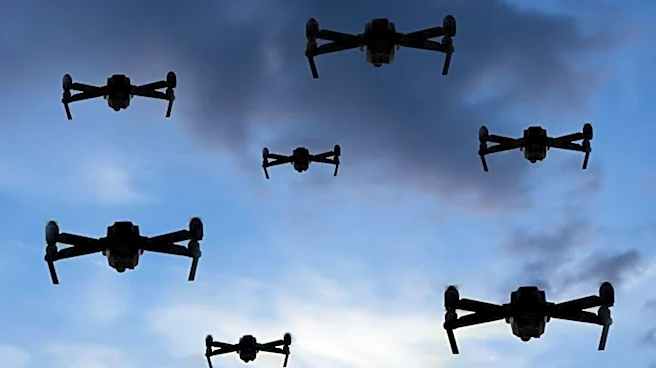
at Camp Jomsborg in Poland. This training is a two-way street, with Western forces sharing practices while also learning from the battle-hardened experience of Ukrainian soldiers, particularly in areas like electronic and drone warfare. Brigadier General Atle Molde, commander overseeing Task Force Legio, stated that Camp Jomsborg serves as a crucial sensor for information, helping Western militaries understand modern combat demands. The war in Ukraine features intense electronic warfare, with both sides constantly developing tactics to disrupt enemy communications, drones, navigation, and sensors while protecting their own. This has underscored the necessity for Western forces to rebuild their EW capabilities, which had atrophied during decades focused on counterinsurgency rather than large-scale conflict.
Why It's Important?
The renewed emphasis on electronic warfare has significant implications for U.S. and NATO military strategy and defense spending. For decades after the Cold War, Western militaries reduced investment in EW, shifting focus to counterinsurgency operations. Russia, however, continued to develop its EW capabilities, creating what Air Chief Marshal Sir Stuart Peach described as 'the most dense and dangerous electromagnetic operating environment we've ever seen' in Ukraine. This oversight means that U.S. and allied forces may be underprepared for peer-on-peer conflicts where control of the electromagnetic spectrum is vital. Rebuilding these capabilities will require substantial investment in research, development, and training, impacting defense budgets and procurement priorities. It also highlights a strategic vulnerability that could be exploited by adversaries, necessitating a rapid adaptation of military doctrine and technological integration to ensure operational effectiveness in future conflicts. The lessons learned from Ukraine are directly informing how Western militaries, including the U.S., will train their own forces and allocate resources.
What's Next?
In response to these revelations, NATO and its member states, including the U.S., are expected to significantly increase investment in electronic warfare capabilities and training programs. This will likely involve a re-evaluation of existing military doctrines to integrate EW more prominently into operational planning. There will be a push to develop and procure advanced EW systems, as well as to enhance the training of personnel in operating and countering such technologies. Furthermore, the collaborative training efforts with Ukraine are likely to continue and expand, serving as a continuous feedback loop for Western militaries to refine their strategies based on real-world combat experience. This ongoing exchange of knowledge will be crucial for adapting to the evolving nature of modern warfare, particularly concerning drone warfare and air defense, which were also identified as areas of renewed importance. The goal is to rebuild and modernize these critical capabilities to deter potential adversaries and ensure readiness for future large-scale conflicts.
Beyond the Headlines
The re-emergence of electronic warfare as a critical domain of conflict signifies a broader shift in military thinking, moving away from the counterinsurgency focus of the post-Cold War era towards preparing for high-intensity, peer-on-peer engagements. This shift has profound implications for the defense industry, driving demand for sophisticated EW technologies, secure communication systems, and advanced drone countermeasures. Ethically, the increased reliance on EW raises questions about the potential for collateral damage in the electromagnetic spectrum, impacting civilian communications and infrastructure. Legally, the use of EW in international conflicts may necessitate new frameworks or interpretations of existing laws of armed conflict. Culturally, it requires a fundamental change in military training and education, fostering a new generation of specialists proficient in the complex interplay of signals, data, and cyber operations. This development underscores the continuous evolution of warfare and the imperative for nations to adapt their defense strategies to maintain a technological and tactical edge.