






What's Happening?
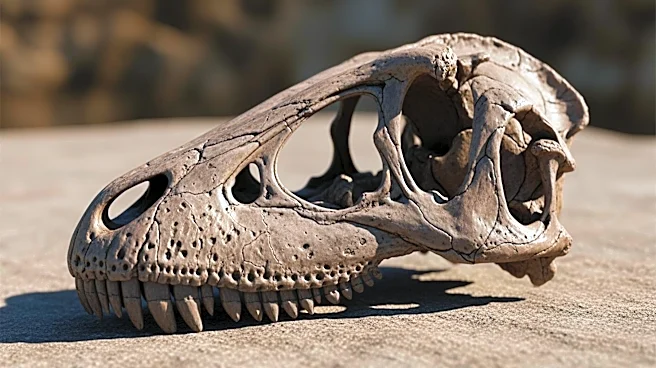
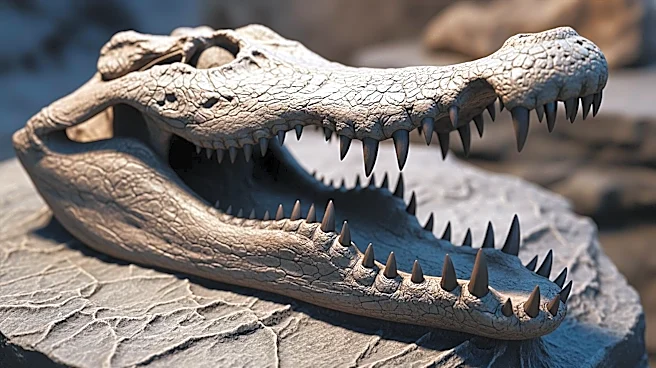
A fossil initially discovered in 1948 at Ghost Ranch, New Mexico, has been reexamined, revealing a new species named Eosphorosuchus lacrimosa. This fossil, previously misidentified and stored in a museum drawer, was found to belong to an early crocodylomorph
with a powerful bite. Using advanced imaging technology, researchers reconstructed the skull, uncovering features that suggest a strong jaw capable of exerting significant force. This discovery, published in the Proceedings of the Royal Society B: Biological Sciences, highlights the diversity and complexity of early crocodile relatives, suggesting they were more ecologically diverse than previously thought.
Why It's Important?
The discovery of Eosphorosuchus lacrimosa provides new insights into the evolutionary history of crocodylomorphs, the group that includes modern crocodiles and alligators. The fossil's unique features, such as a reinforced snout and strong jaw muscles, indicate specialized adaptations for a powerful bite. This suggests that early crocodylomorphs were evolving diverse traits to exploit different ecological niches, challenging previous assumptions about their uniformity. Understanding these evolutionary pathways can help scientists better comprehend the adaptive strategies of ancient reptiles and their role in prehistoric ecosystems.