



What's Happening?
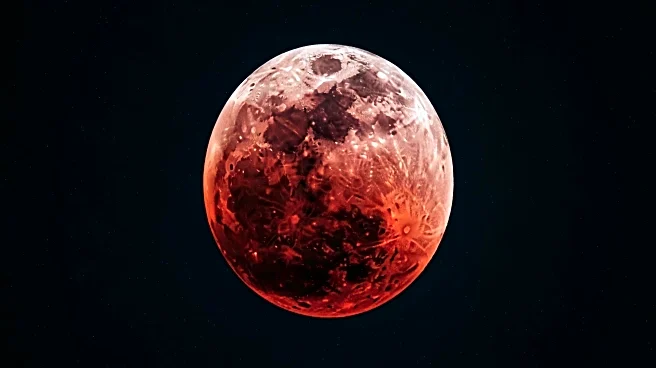
A rare total lunar eclipse, known as a 'blood moon,' will be visible over North America, Australia, and New Zealand on March 3, 2026. During this event, the full moon will pass into Earth's shadow, taking on a deep, coppery-red hue. This phenomenon occurs
when sunlight is refracted through Earth's atmosphere, casting a reddish tint on the moon. Astrophysicist Dr. Rebecca Allen from Swinburne University explains that this will be the last opportunity to witness such an event for nearly three years. The eclipse will be visible in the early morning hours in North America, with specific viewing times varying by location. For example, in New York and Washington DC, the eclipse will start at 3:44 AM and end around 6:30 AM. The event is expected to draw interest from both amateur and professional astronomers, as well as the general public.
Why It's Important?
The 'blood moon' eclipse is significant as it offers a rare opportunity for people to engage with a dramatic astronomical event. Such occurrences can inspire interest in astronomy and science, encouraging people to explore the night sky. The event also serves as a reminder of Earth's place in the solar system and the dynamic nature of celestial bodies. For scientists, it provides a chance to study the Earth's atmosphere and its effects on light. The cultural and historical significance of lunar eclipses, which have been interpreted in various ways by different civilizations, adds an additional layer of interest. This event could also have implications for tourism, as people may travel to locations with optimal viewing conditions.
What's Next?
Following this eclipse, the next total lunar eclipse visible in North America will occur in June 2029. In the meantime, a partial lunar eclipse is expected on August 28, 2026, which will be best viewed from the Americas and Africa. These future events will continue to provide opportunities for public engagement with astronomy. Additionally, scientists may use data from the upcoming eclipse to further study atmospheric conditions and refine models of light refraction. Public interest in such celestial events could lead to increased support for space exploration and scientific research.
Beyond the Headlines
Lunar eclipses have historically been imbued with cultural and mythological significance. In ancient times, they were often seen as omens or supernatural events. For instance, the Inca believed a lunar eclipse was caused by a jaguar attacking the moon. In modern times, while the scientific understanding of these events has dispelled many myths, they still capture the public's imagination. The 'blood moon' phenomenon also highlights the interconnectedness of Earth and its celestial neighbors, offering a moment of reflection on humanity's place in the universe. This event may also spark discussions about the importance of preserving dark skies for astronomical observation, as light pollution continues to be a growing concern.