




What's Happening?
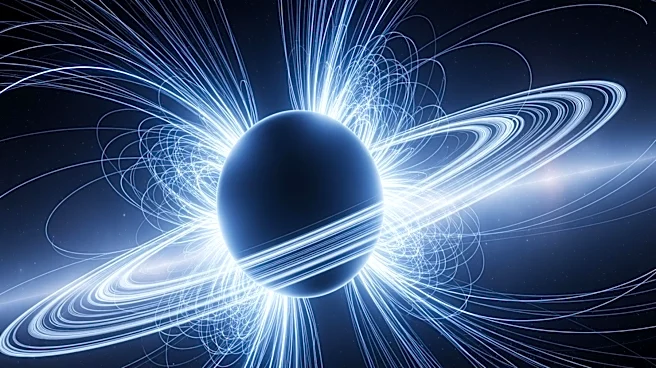
New research involving scientists from University College London has revealed that Saturn's magnetic field is not symmetrical like Earth's but is instead noticeably uneven. This distortion is attributed to the planet's rapid rotation and the dense plasma
environment surrounding it, primarily sourced from its moon Enceladus. The findings, published in Nature Communications, are based on six years of observations from NASA's Cassini mission. The study focused on Saturn's magnetic cusp, a region where magnetic field lines bend back toward the poles, allowing charged particles to enter the atmosphere. The cusp was found to be consistently shifted to one side, a phenomenon linked to Saturn's fast rotation and the plasma environment. This research provides critical evidence for the theory that the rapid spin of massive planets with active moons replaces the solar wind as the dominant force shaping magnetospheres.
Why It's Important?
Understanding Saturn's magnetic field is crucial for comprehending the planet's environment and its interactions with the solar wind. The study's findings have implications for future missions to Saturn and its moons, particularly Enceladus, which is of interest due to its potential to support life. The research also contributes to the broader understanding of planetary magnetospheres, suggesting that the magnetospheres of rapidly spinning gas giants differ fundamentally from Earth's. This knowledge is essential for planning future space missions and for understanding the dynamics of other planetary systems, including exoplanets.
What's Next?
The study's results will inform future missions to Saturn, particularly those targeting Enceladus. The European Space Agency is planning a mission to Enceladus in the 2040s, which will focus on searching for signs of habitability and potential life. Further simulations and observations will be needed to confirm the study's findings and to explore the implications for other gas giants in the solar system. The research also opens up new avenues for studying the interactions between planetary magnetospheres and the solar wind, which could have implications for understanding exoplanetary systems.