







What's Happening?
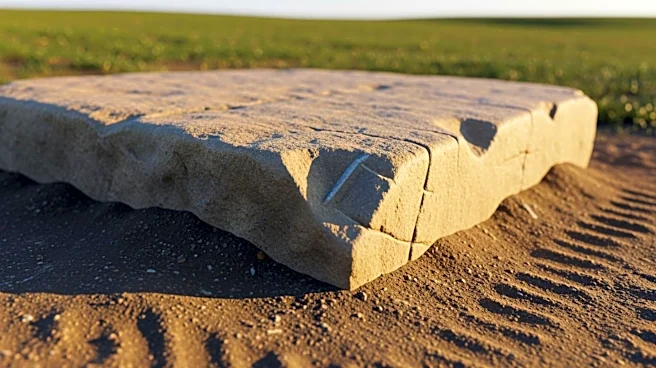
A new study published in the Journal of Quaternary Science suggests that the Altar Stone at Stonehenge was likely transported by human effort rather than glacial movement. Researchers modeled ancient ice flows and found no direct glacial path from Scotland
to Stonehenge, indicating that Neolithic communities probably moved the stone overland and via waterways. The study highlights the sophisticated coordination required to transport the 16-foot, 13,000-pound stone over 450 miles from Scotland to southern England. This challenges previous theories that glaciers played a significant role in the stone's journey.
Why It's Important?
The research underscores the advanced organizational skills and technological capabilities of Neolithic societies. Moving such a massive stone over long distances would have required significant planning and cooperation, suggesting a high level of social complexity. This finding contributes to the understanding of prehistoric engineering and the cultural significance of Stonehenge. It also highlights the importance of human agency in shaping historical landscapes, offering insights into the motivations and methods of ancient builders.
What's Next?
Further research is needed to explore the specific routes and methods used by Neolithic communities to transport the Altar Stone. Scientists may investigate other stones at Stonehenge to determine if similar human efforts were involved in their placement. This ongoing research could provide a more comprehensive understanding of the construction of Stonehenge and the cultural practices of its builders, offering new perspectives on prehistoric societies.