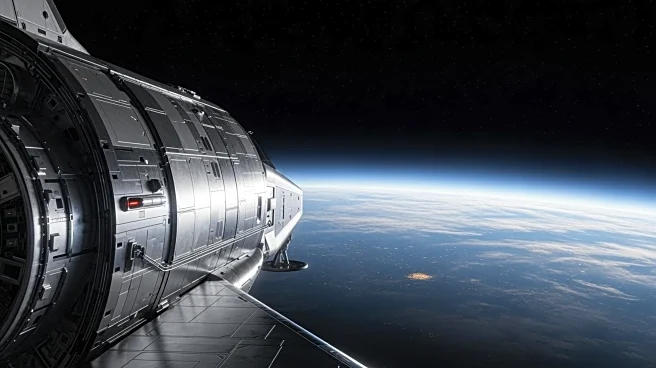




What's Happening?
Chris Williams, an astronaut from Potomac, Maryland, has fulfilled his lifelong dream of traveling to space. Williams, who has an extensive background in astrophysics and clinical physics, launched from Kazakhstan to the International Space Station (ISS)
last month. He is part of a crew conducting stem cell research and working with artificial intelligence during an eight-month mission. Williams' journey to becoming an astronaut was inspired by his childhood fascination with space and shows like 'Star Trek.' His upbringing in Montgomery County, Maryland, played a significant role in fostering his interest in science, providing him with opportunities to engage in research at federal labs. Williams is currently adapting to the unique experience of microgravity and is scheduled to participate in spacewalks in January.
Why It's Important?
Williams' mission highlights the ongoing international collaboration in space exploration, as the ISS involves partnerships with 15 different countries. His work on stem cell research and artificial intelligence could have significant implications for scientific advancements and technological innovations. The mission also underscores the importance of educational opportunities in nurturing future scientists and explorers. Williams' story serves as an inspiration for young people interested in STEM fields, demonstrating the potential for achieving ambitious goals through dedication and education. The research conducted on the ISS could lead to breakthroughs that benefit various sectors, including healthcare and technology.
What's Next?
Williams is expected to participate in spacewalks scheduled for January, which will be a critical component of his mission. These spacewalks are essential for maintaining the ISS and conducting experiments. The outcomes of the research conducted during this mission could influence future space exploration strategies and international collaborations. As Williams continues his mission, he will maintain communication with his family and friends, emphasizing the personal sacrifices and challenges faced by astronauts during long-duration spaceflights. The mission's findings may also contribute to discussions on the future of human space exploration and the potential for extended missions beyond Earth's orbit.