







What's Happening?
Proxima Fusion, Europe's leading fusion company, is set to use additive manufacturing (AM) to construct its net-energy stellarator demonstrator, Alpha. Scheduled for construction in 2027 and operation by 2031, Alpha aims to validate technologies crucial
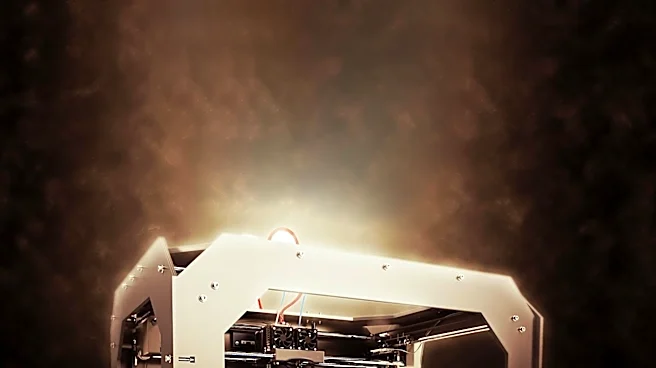
for the development of the world's first fusion power plant. The project is a collaboration with the state of Bavaria, the Max Planck Institute for Plasma Physics, and RWE. Proxima Fusion recently secured €411 million ($468 million) in funding, making it the best-funded fusion company in Europe. The funding round was led by XTX Ventures and East X Ventures, with strategic investments from RWE and Google. The project will utilize AM to create complex geometries required for the stellarator's external coils and supports, which are challenging to produce with conventional machining.
Why It's Important?
The development of a net-energy stellarator represents a significant step forward in fusion energy research, which has the potential to provide a nearly limitless and clean energy source. Proxima Fusion's use of additive manufacturing highlights the role of advanced technologies in overcoming engineering challenges associated with fusion reactors. The successful implementation of this project could position Europe as a leader in fusion energy, competing with the United States and China. The substantial investment in Proxima Fusion underscores the growing confidence in fusion technology as a viable energy solution, which could have far-reaching implications for global energy markets and efforts to combat climate change.
What's Next?
As Proxima Fusion progresses with the Alpha project, the focus will be on refining the technologies and processes necessary for the construction of a commercial fusion power plant. The collaboration with key scientific and industrial partners will be crucial in achieving these goals. The success of the Alpha demonstrator could accelerate the timeline for commercial fusion energy deployment, potentially transforming the energy landscape. Continued investment and innovation in fusion technology will be essential to overcoming the remaining technical and financial challenges. The project's outcomes could influence energy policy and investment strategies worldwide, as countries seek sustainable energy solutions.