






What's Happening?
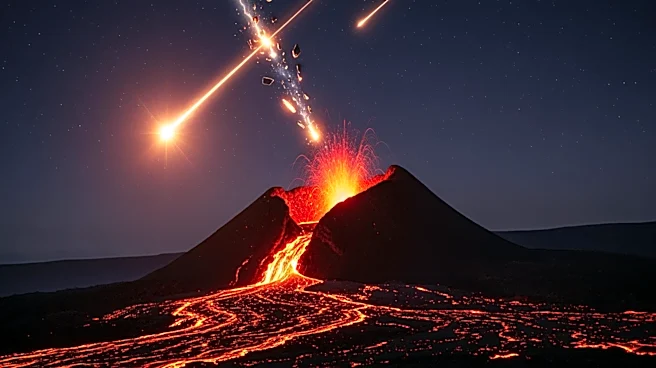
A bright-green 'fireball' meteor was observed exploding over Mount Mayon, an erupting volcano in the Philippines. The event was captured by two livestreams monitoring the volcano's activity. Initial reports suggested the meteor might have struck the volcano's slopes,
but experts later confirmed it disintegrated in the atmosphere. The Philippine Space Agency and the Philippine Institute of Volcanology and Seismology (PHIVOLCS) provided updates, clarifying that no impact occurred. The meteor's explosion was a visually striking event, coinciding with the ongoing volcanic eruption, which began in early January. The meteor's green hue is attributed to a high concentration of nickel, and it disintegrated due to friction with the atmosphere.
Why It's Important?
The occurrence of a meteor explosion over an erupting volcano is a rare and visually dramatic event, drawing attention to the dynamic interactions between celestial and terrestrial phenomena. While the meteor did not impact the volcano, its presence highlights the potential risks associated with meteors entering Earth's atmosphere. Such events can have significant implications for understanding atmospheric entry dynamics and the potential hazards posed by meteors. The incident also underscores the importance of monitoring volcanic activity and celestial events, as both can have profound effects on local environments and communities.
What's Next?
Following the meteor explosion, experts will likely continue to analyze data from the event to better understand the dynamics of meteors entering Earth's atmosphere. This analysis could contribute to improved predictive models for meteor impacts and enhance monitoring systems for both volcanic and celestial activities. Additionally, the ongoing eruption of Mount Mayon will continue to be closely observed by PHIVOLCS and other agencies to ensure the safety of nearby communities and to study the volcano's behavior.
Beyond the Headlines
The meteor explosion over Mount Mayon serves as a reminder of the interconnectedness of Earth's systems and the universe. It highlights the need for interdisciplinary research that combines astronomy, geology, and atmospheric sciences to fully understand such phenomena. The event also raises awareness about the potential for meteors to impact populated areas, emphasizing the importance of global monitoring networks and international collaboration in tracking near-Earth objects.