




What's Happening?
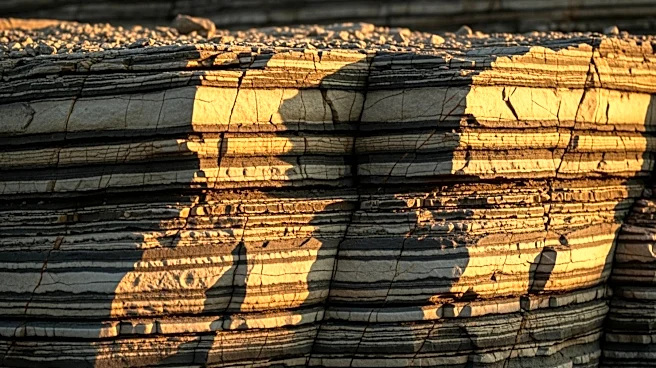
Recent research published in Earth and Planetary Physics has uncovered evidence that the collision between Central and South America occurred millions of years earlier than previously believed. This discovery was made through the analysis of magnetic
signatures in volcanic rocks from Colombia, which act as time capsules preserving the conditions of their formation. The study challenges the traditional timeline, suggesting that significant tectonic activity began during the Oligocene-middle Miocene period, rather than in the later stages as previously thought. This earlier collision led to the formation of a land bridge, which significantly impacted ocean currents and global ecosystems by allowing species migration between continents.
Why It's Important?
The findings have profound implications for understanding Earth's geological history and the evolution of its climate and ecosystems. By shifting the timeline of the Americas' collision, scientists must reconsider the timing of major geological and environmental changes, such as the formation of the Isthmus of Panama. This land bridge played a crucial role in altering ocean circulation and climate patterns, which in turn affected global biodiversity. The study emphasizes the complexity of tectonic processes, highlighting the need for integrating diverse geological evidence to accurately reconstruct Earth's past.
What's Next?
As researchers continue to refine their models, the understanding of how the Americas came together is expected to evolve. This study opens new avenues for exploring the intricate interactions between tectonic plates and their long-term impacts on the planet's climate and biological diversity. Future research will likely focus on further analyzing geological records and integrating various scientific disciplines to build a more comprehensive picture of Earth's tectonic history.
Beyond the Headlines
The study underscores a shift in geological perspectives, moving away from simplified narratives towards recognizing the gradual and complex nature of tectonic processes. This approach aligns with emerging views in geology that emphasize the importance of prolonged interactions and multiple lines of evidence in understanding Earth's history. The research also highlights the potential for new discoveries in well-studied areas, suggesting that even established scientific narratives can be redefined with fresh insights.