



What's Happening?
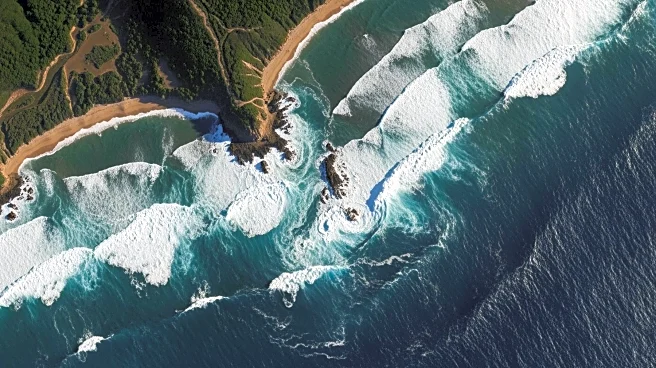
In the summer of 2025, a significant 8.8-magnitude earthquake occurred off the coast of Russia's Kamchatka Peninsula, triggering a tsunami that spread across the Pacific Ocean. NASA's SWOT satellite, launched in 2022, captured detailed imagery of the tsunami,
marking the largest event it has recorded to date. The satellite, along with NOAA's DART system, provided data that allowed researchers to map the earthquake's rupture zone, which extended approximately 250 miles and lifted parts of the seafloor by up to 13 feet. This data was crucial in understanding the tsunami's formation and propagation, offering scientists a comprehensive model to study.
Why It's Important?
The data collected by NASA's SWOT satellite and NOAA's DART system is transforming the scientific understanding of tsunamis. By providing high-resolution imagery and real-time data, these technologies enhance the ability to track and predict such events, potentially improving emergency response strategies. The comparison of the 2025 earthquake with a similar event in 1952 challenges existing hazard models, which typically expect massive earthquakes to be separated by hundreds of years. This new understanding could lead to revised models and better preparedness for future seismic activities, ultimately aiding in the protection of coastal communities.
What's Next?
The integration of satellite and buoy data is expected to revolutionize real-world responses to tsunami emergencies. Scientists are exploring how this system can be used in conjunction with coastal warning systems to enhance public safety. The ability to quickly provide accurate data on tsunami waves can significantly improve evacuation strategies and reduce the risk of casualties. Continued research and development in this area may lead to more reliable and efficient warning systems, offering better protection for vulnerable regions.
Beyond the Headlines
The advancements in satellite technology, as demonstrated by the SWOT satellite, highlight the growing importance of space-based observation in natural disaster management. This event underscores the need for international collaboration in monitoring and responding to seismic activities, as tsunamis can have far-reaching impacts across multiple countries. The ethical considerations of sharing data and resources globally to mitigate the effects of natural disasters are becoming increasingly relevant, prompting discussions on international policies and cooperation.