
What's Happening?
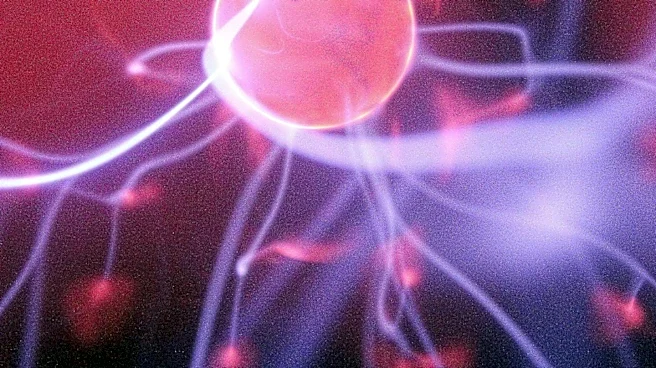
Neon gas, when excited by an electric discharge, produces a characteristic orange-red glow because its light spectrum is dominated by red and orange lines, particularly around 640 nanometers. This specific
emission signature was crucial to its discovery in 1898 by chemists William Ramsay and Morris Travers, who observed these brilliant red lines in a newly isolated gas from liquefied air and named it 'neon,' meaning 'new' in Greek. The distinct color of neon is a result of its atomic structure, where excited atoms emit only these precise wavelengths. Other colors seen in glass signs are achieved through different gases or fluorescent powders, while LED neons utilize colored diodes to produce various hues.
Why It's Important?
Understanding the light spectrum of gases like neon is fundamental to various scientific and commercial applications, particularly in lighting and display technologies. The unique spectral properties of neon allow for its use in iconic signage, creating specific visual effects that have been culturally significant since Georges Claude commercialized neon signs in 1910. This scientific principle also underpins the development of other lighting technologies, such as LED neons, which mimic the visual appeal of traditional neon without using gas. For consumers and businesses, the choice of lighting, whether for ambiance in a living room or for highlighting materials in a commercial space, is directly influenced by the light spectrum and color temperature, impacting aesthetics and even human well-being by affecting sleep rhythms.
What's Next?
The ongoing evolution in lighting technology continues to leverage principles of light spectrum and gas excitation. While traditional neon signs maintain their aesthetic appeal, advancements in LED technology offer alternatives that can replicate neon's distinct colors with greater energy efficiency and versatility. Future developments may focus on refining LED technology to more accurately mimic the precise spectral emissions of various gases, potentially leading to new forms of dynamic and customizable lighting solutions. Research into the effects of different light spectra on human health and mood is also likely to influence future lighting design, with an emphasis on creating environments that support well-being, such as favoring warm white lights in the evening to avoid disrupting sleep.
Beyond the Headlines
The study of light spectra extends beyond commercial applications into fundamental scientific research, such as spectroscopy, which allows scientists to determine the composition of distant stars by analyzing their unique spectral 'fingerprints.' This interdisciplinary field highlights the profound impact of understanding light on various scientific disciplines. The distinction between continuous spectra (like sunlight) and line spectra (like neon) reveals the quantum nature of matter and energy. Furthermore, the cultural impact of neon lighting, from its role in urban landscapes to its influence on art and design, demonstrates how scientific discoveries can profoundly shape human environments and aesthetics, creating focal points and defining atmospheres in diverse settings.