


What's Happening?
The California Infrastructure and Economic Development Bank (IBank) has finalized a $236 million revenue bond to fund the extensive revamp of the La Brea Tar Pits and George C. Page Museum in Los Angeles. Governor Newsom announced the bond, which will
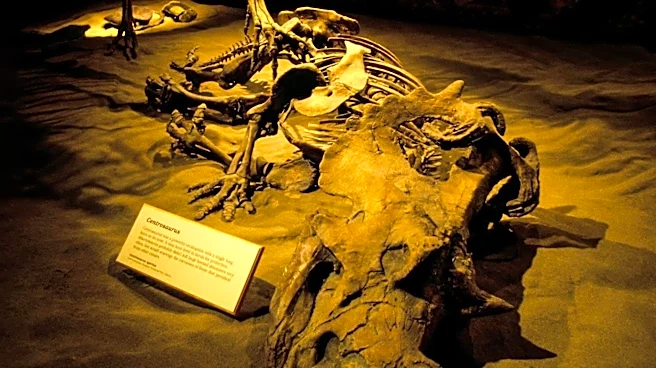
support the first phase of a master plan designed by Weiss/Manfredi. The museum complex, which closed on July 6 for a two-year period, will undergo significant transformations. This initial phase includes an expansion of the Page Museum, modifications to berms to create new outdoor gathering areas and museum access points, and updates to signage, lighting, landscaping, and furniture across the 13-acre site. A key addition will be the Samuel Oschin Global Center for Ice Age Research, dedicated to studying how ancient ecosystems responded to climate change and extinction events. The completion of this first phase is anticipated by mid-2028.
Why It's Important?
This substantial investment in the La Brea Tar Pits revamp is important for several reasons, impacting both scientific research and public engagement. The creation of the Samuel Oschin Global Center for Ice Age Research will significantly enhance Los Angeles's role as a hub for paleontological and climate science. This center will provide a dedicated facility for studying ancient ecosystems and their responses to past climate change and extinction events, offering valuable insights into current environmental challenges. For the public, the expanded and modernized museum will transform the visitor experience, making the rich history of the Ice Age more accessible and engaging for millions. This project also represents a significant economic investment in Los Angeles's cultural infrastructure, potentially boosting tourism and educational opportunities, and solidifying the region's reputation as a center for scientific discovery and cultural heritage.
What's Next?
The first phase of the La Brea Tar Pits revamp, including the expansion of the Page Museum and the establishment of the Samuel Oschin Global Center for Ice Age Research, is expected to be completed by mid-2028. Following this, the master plan outlines subsequent phases that will involve the construction of new entrance pavilions, walkways, a parking lot, and an additional research building. The entire master plan is projected to unfold over approximately seven years, ensuring continuous development on Museum Row. This long-term commitment indicates a sustained effort to enhance the scientific and public offerings of the La Brea Tar Pits. Stakeholders, including the scientific community, local residents, and tourists, can anticipate a phased transformation that will progressively unveil new facilities and research capabilities, further cementing the site's importance as a global center for Ice Age studies.
Beyond the Headlines
The revamp of the La Brea Tar Pits and the establishment of the Samuel Oschin Global Center for Ice Age Research carry deeper implications for how society understands and interacts with its ancient past and future environmental challenges. Ethically, the center's focus on ancient ecosystems' responses to climate change underscores the urgency of current climate action, drawing parallels between past extinction events and present-day environmental threats. Culturally, the modernization of the museum will likely enhance public appreciation for paleontology and the scientific process, fostering a greater connection to the natural history of the region and the planet. This project also highlights a growing trend in museum development towards integrating cutting-edge research with public education, transforming cultural institutions into dynamic centers of discovery. The long-term impact could be a more informed public, better equipped to understand and address complex environmental issues through the lens of deep time.