






What's Happening?
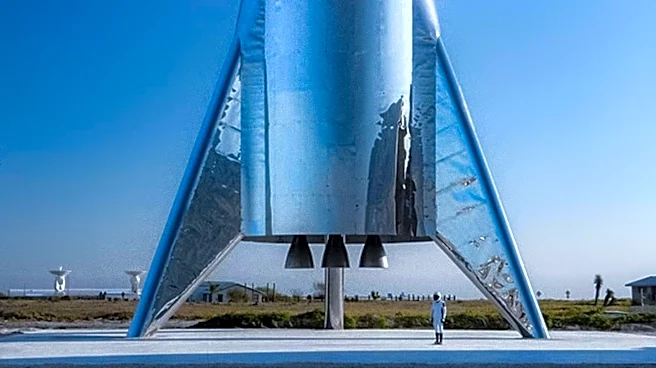
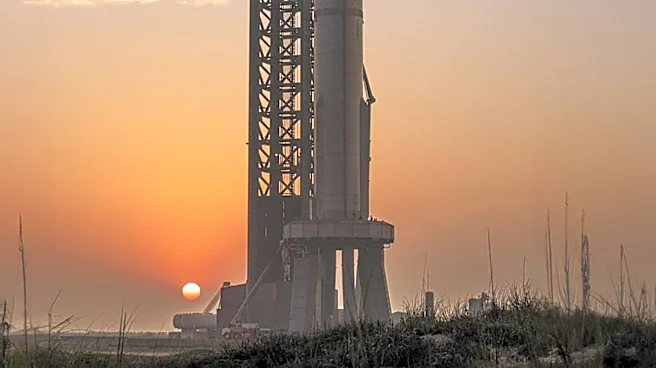
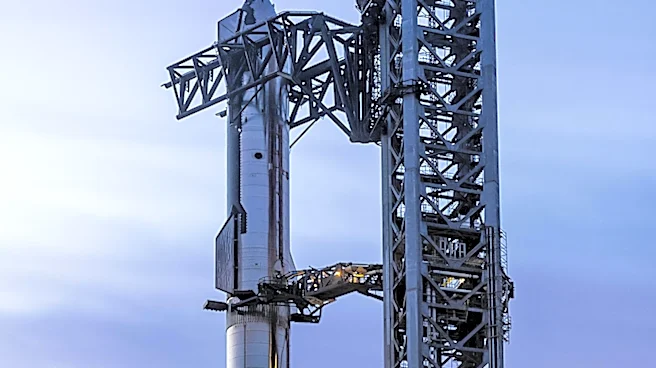
On September 28, 2026, SpaceX successfully conducted its first orbital deployment of Starlink satellites using the Starship vehicle. During this mission, Starship launched into Earth orbit and deployed a total of 27 Starlink satellites, including 26 of the V3
model. Three of these satellites were specially modified with integrated cameras to monitor the condition of Starship's heat shield during flight, providing crucial data for future missions. This successful deployment marks a significant milestone for the Starship program, demonstrating its capability as a heavy-lift launch system for operational space activities and integrating it into the Starlink constellation deployment schedule. The mission signals a strategic shift towards utilizing large-scale heavy-lift systems for routine network expansion, moving beyond sole reliance on smaller launch platforms.
Why It's Important?
This successful mission is a pivotal moment for SpaceX and the broader space industry. The integration of Starship into Starlink deployment signifies a major leap in satellite launch capabilities, promising to accelerate the expansion of the Starlink constellation. This could lead to higher-density satellite networks, which in turn would enhance global internet bandwidth and connectivity, potentially offering more reliable signal coverage for consumers worldwide. For the U.S. aerospace industry, it validates the development of reusable heavy-lift rockets, showcasing advanced engineering and operational efficiency. This achievement could also drive down the cost of launching large payloads into orbit, making space access more economical for various applications, including scientific research, national security, and commercial ventures.
What's Next?
The successful deployment of Starlink satellites by Starship is expected to pave the way for more frequent and larger-scale deployments of the constellation. SpaceX will likely continue to refine Starship's operational procedures and heat shield monitoring techniques to ensure vehicle longevity and reusability during orbital reentry. This development could accelerate the timeline for achieving a fully global and robust Starlink internet service. Furthermore, the proven capability of Starship as a heavy-lift platform opens doors for other ambitious SpaceX projects, including lunar and Martian missions, as well as the deployment of even larger and more complex satellite systems for various governmental and commercial clients. The aerospace industry will closely watch how this new capability impacts launch costs and competition.
Beyond the Headlines
The successful deployment by Starship represents a paradigm shift in space logistics, moving towards an era where massive payloads can be routinely and cost-effectively launched into orbit. This could have profound implications for various sectors beyond internet connectivity, including Earth observation, space-based manufacturing, and even space tourism. The ability to deploy hundreds or thousands of satellites at once could lead to entirely new constellations for diverse purposes, from advanced weather monitoring to global navigation systems. Ethically, the increased deployment of large satellite constellations raises questions about space debris, orbital traffic management, and the long-term sustainability of Earth's orbital environment, prompting calls for international cooperation and regulatory frameworks to manage this new era of space utilization.