






What's Happening?
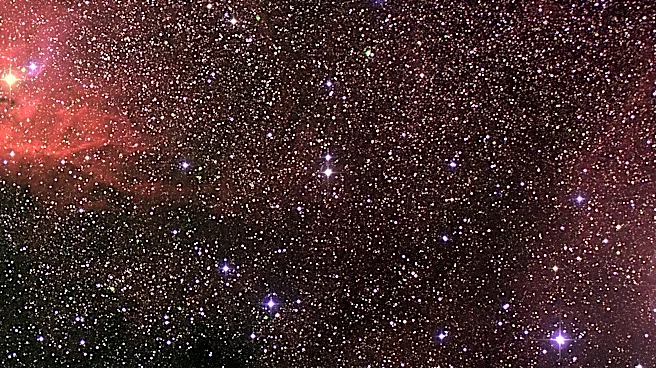
A group of students from the University of Chicago has discovered an ultra-ancient star, SDSS J0715-7334, in the Milky Way that is almost devoid of metals. This star, which formed in another galaxy, was identified using data from the Sloan Digital Sky
Survey (SDSS). The star's lack of heavy elements suggests it is one of the oldest and most pristine stars ever observed. The discovery was made during an astronomy class led by Professor Alex Ji, where students were tasked with examining thousands of stars. The star's unique characteristics indicate it originated in the Large Magellanic Cloud and later drifted into the Milky Way.
Why It's Important?
The discovery of SDSS J0715-7334 is significant as it provides a rare glimpse into the conditions of the early universe. The star's minimal metal content suggests it formed before most supernovae, offering insights into the universe's early chemical composition. This finding challenges existing models of galactic evolution and highlights the potential for student-led research to contribute to major scientific discoveries. The star's journey from another galaxy also provides valuable data on intergalactic dynamics and the Milky Way's history.
Beyond the Headlines
This discovery underscores the importance of educational initiatives that involve students in real-world research. The involvement of students in such a significant finding demonstrates the value of hands-on learning and collaboration in scientific education. It also highlights the potential for big data projects like SDSS to democratize access to advanced research tools, enabling young researchers to make meaningful contributions to science.