
What's Happening?
Connecticut Secretary of the State Stephanie Thomas has assured the public of the security of the state's voting machines, following claims from the White House regarding national security risks from foreign-made
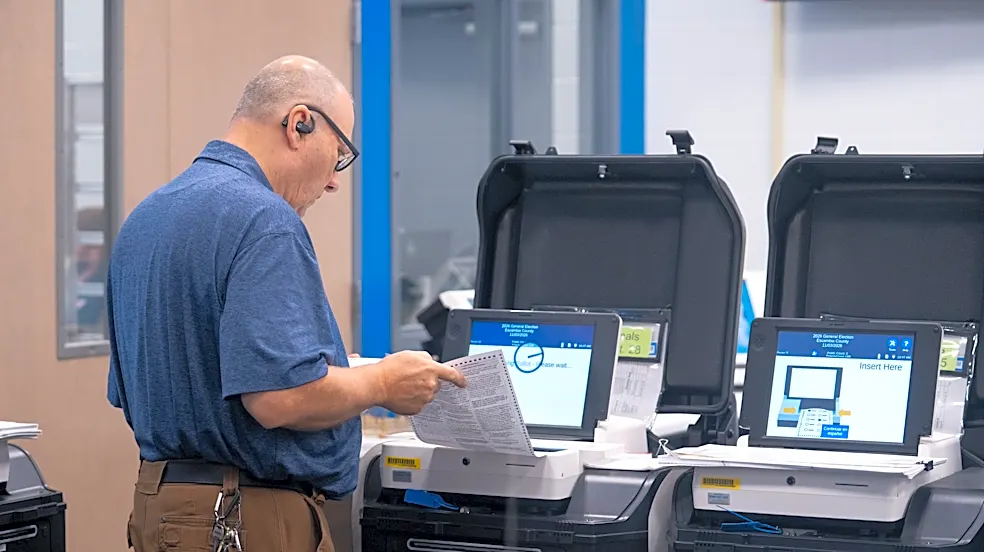
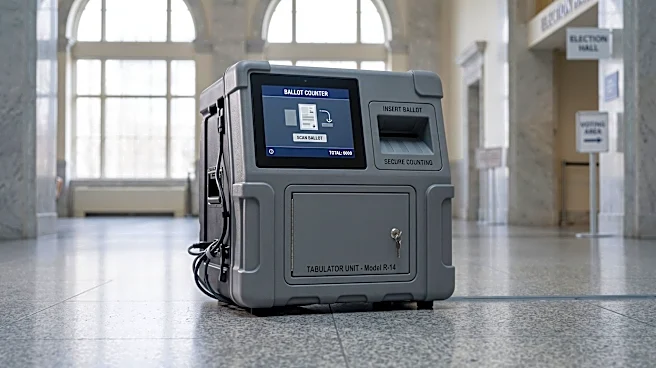
components. In 2024, before investing $20 million in new voting equipment, Secretary Thomas enlisted researchers from UConn's Voting Technology Research (VoTeR) Center to conduct 'white-hat hacking' attempts on tabulators from competing companies. Dr. Alexander Russell, director of the VoTeR Center, reported that researchers spent days trying to find vulnerabilities in both hardware and software before giving high marks to Election Systems & Software (ES&S) equipment. This led to the deployment of approximately 2,500 new ES&S tabulators for the 2025 Municipal Election. Secretary Thomas emphasized that Connecticut's tabulators are not connected to the internet, preventing remote access, and the state continues to use hand-marked paper ballots for physical records and post-election audits.
Why It's Important?
The rigorous testing and multiple safeguards implemented by Connecticut are crucial for maintaining public confidence in election integrity, especially amidst ongoing national concerns about voting machine security and foreign interference. By proactively attempting to hack its own machines, Connecticut has demonstrated a commitment to transparency and security, directly addressing fears that could undermine democratic processes. The use of paper ballots provides a verifiable audit trail, reinforcing the accuracy of electronic counts and offering a crucial fallback in case of discrepancies. This approach helps to counter misinformation and ensures that voters can trust that their ballots are counted accurately and securely, which is fundamental to a healthy democracy. The state's comprehensive security measures, from pre-purchase testing to post-election audits, set a high standard for election administration.
What's Next?
Connecticut's election security measures extend beyond the initial purchase and deployment of machines. Before each election, local officials conduct public logic and accuracy testing to verify tabulator functionality. Strict procedures govern the preparation, storage, transportation, and handling of voting equipment and ballots. After elections, post-election audits compare electronic results with paper ballots to identify discrepancies and verify accuracy. While voting tabulators, like many electronic products, contain foreign-made components, Secretary Thomas asserts that this does not mean equipment is compromised or votes can be changed remotely. The state's continuous, multi-layered approach to election security aims to ensure that the integrity of the voting process is maintained year-round, not just on Election Day.
Beyond the Headlines
The proactive security measures taken by Connecticut highlight a broader national challenge in balancing technological advancement with security and public trust in electoral systems. The 'white-hat hacking' approach exemplifies a best practice in cybersecurity, demonstrating that rigorous, independent testing can identify and mitigate vulnerabilities before they are exploited. This also underscores the importance of collaboration between state election officials and academic institutions in safeguarding democratic processes. The ongoing debate about foreign-made components in voting machines points to a larger discussion about supply chain security in critical infrastructure and the need for domestic manufacturing capabilities for sensitive technologies. Ultimately, Connecticut's efforts contribute to a national dialogue on how to build resilient, transparent, and trustworthy election systems in an increasingly complex technological and geopolitical landscape.