
What's Happening?
NASA's Solar Dynamics Observatory recently captured a solar flare, highlighting the potential disruptions caused by solar storms on Earth. These storms can affect power grids, rail systems, satellites,
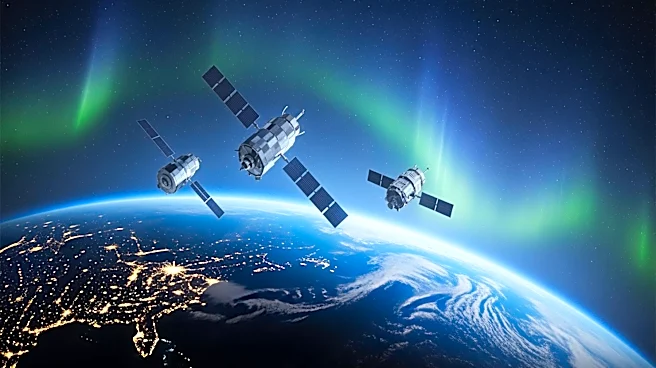
and marine life by disturbing the magnetosphere-ionosphere system. A recent example of such disruption occurred in February 2022, when SpaceX lost 38 out of 49 Starlink satellites due to a moderate geomagnetic storm. In response to these challenges, the European Space Agency has launched the Swarm-AWARE project. This initiative aims to use data from Swarm satellites, along with ground-based and Copernicus Sentinel-5P observations, to differentiate between ionospheric electromagnetic signatures caused by space weather and those linked to natural hazards. The project seeks to improve infrastructure, communications, and early-warning systems by advancing the understanding of space weather impacts.
Why It's Important?
The Swarm-AWARE project is crucial for enhancing the accuracy of space weather predictions, which can significantly impact various sectors. By distinguishing between space weather effects and natural hazard signals, the project aims to protect infrastructure and improve decision-making processes. The loss of SpaceX satellites underscores the vulnerability of technological systems to geomagnetic storms, highlighting the need for better forecasting. Improved predictions can help mitigate risks to communication networks, power grids, and other critical infrastructure, ultimately safeguarding economic and societal interests. The project's findings could lead to more reliable early-warning systems, reducing the potential for widespread disruptions.
What's Next?
The Swarm-AWARE team plans to apply machine learning and advanced time series analysis to the collected satellite and ground data. This approach aims to deepen the understanding of space weather's effects on infrastructure and move towards more reliable predictions. The project's outcomes are expected to support future scientific research and assist organizations in making informed decisions in real-time. As the project progresses, it may lead to the development of new technologies and strategies for mitigating the impacts of space weather, benefiting industries and governments worldwide.
Beyond the Headlines
The Swarm-AWARE project not only addresses immediate technological challenges but also contributes to the broader understanding of Earth's atmospheric dynamics. By integrating diverse datasets, the project could reveal new insights into the interactions between space weather and natural phenomena. This knowledge may influence future policies and strategies for managing space weather risks, fostering international collaboration in space research and technology development. The project's success could also inspire similar initiatives, promoting innovation and resilience in the face of growing environmental and technological challenges.